



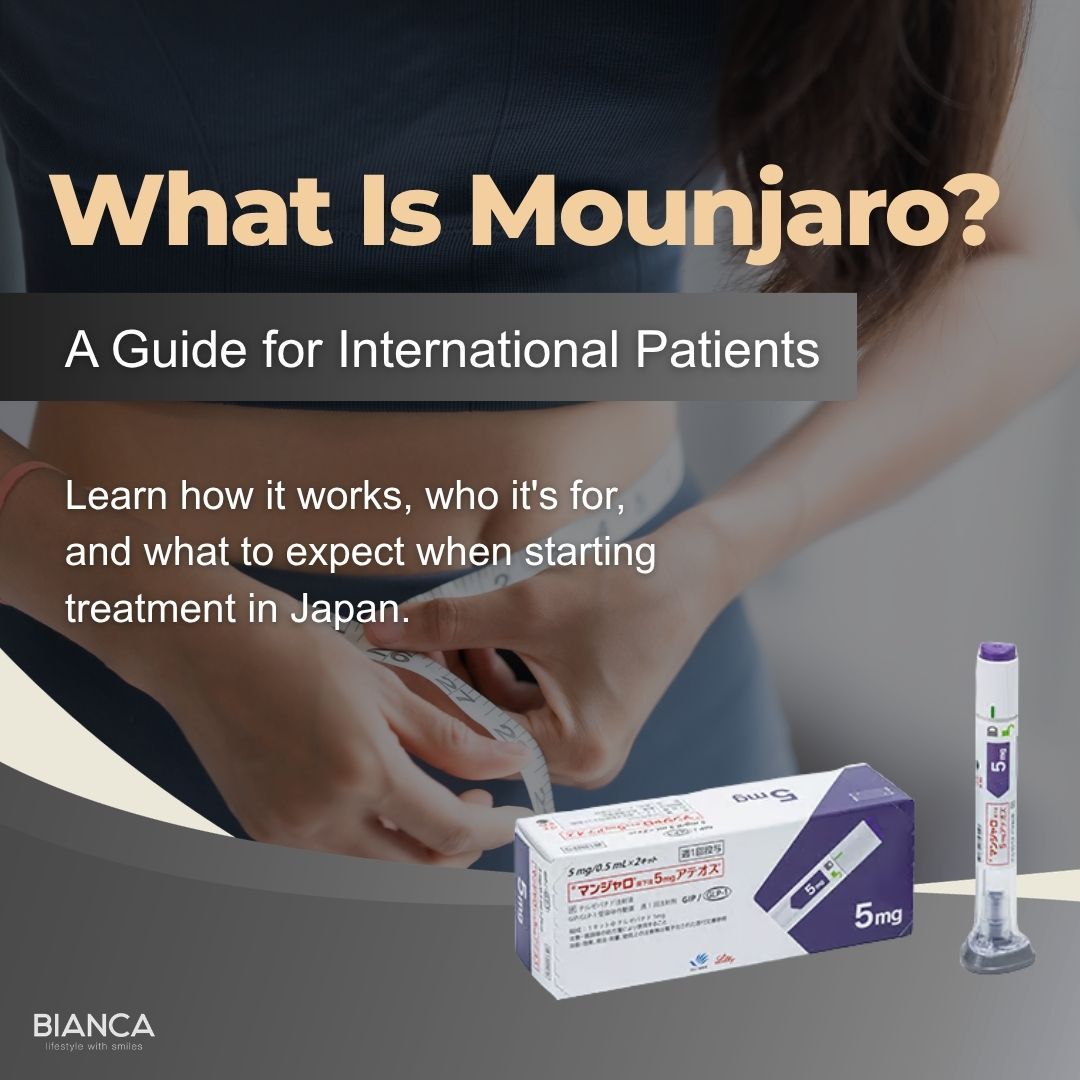
What is Mounjaro? It’s one of the most common questions we hear from international patients considering weight loss treatment in Japan.
It’s a fair question—and often a more complicated one than it first appears.
There’s no shortage of information online—forums, before-and-after photos, dosage charts, and price comparisons.
What’s harder to find is guidance on whether Mounjaro actually fits your body, your goals, and your circumstances, especially if you’re planning treatment while visiting or living in Japan.
This article draws on the questions we’re actually asked in consultations at BIANCA CLINIC, rather than repeating what a product label already tells you.
Quick Answer: What Is Mounjaro?
- Mounjaro (tirzepatide) is a prescription medication that activates both GLP-1 and GIP receptors to help regulate appetite and support weight management.
- In Japan, it is prescribed only after a physician evaluates medical suitability.
- At BIANCA CLINIC, treatment decisions are based on BMI, medical history, lifestyle, medications, and, when appropriate, blood test results.
- International patients can begin treatment in Japan if they meet the medical criteria.
Why Patients Ask About Mounjaro During Consultations

Patients rarely walk in already fixated on tirzepatide as a molecule.
They come in with a specific frustration, and Mounjaro is one possible answer to it.
“I’ve tried dieting, but nothing seems to work anymore.”
This is probably the most common opening line we hear.
Many patients have already tried calorie counting, structured exercise programs, or other diets, sometimes for years, with results that don’t stick.
It’s not that patients lack willpower— appetite regulation involves hormonal signaling that diet alone doesn’t always override.
This is usually the point where a patient starts asking what a GLP-1/GIP medication actually does differently.
“I’m constantly thinking about food.”
Patients often describe this without knowing there’s a term for it: food noise, the near-constant mental background chatter around eating, snacking, or what’s next on the plate.
It’s exhausting, and it’s not something most people can simply decide to stop.
GLP-1/GIP receptor agonists like Mounjaro are thought to act on appetite-regulating centers in the brain, which is often why patients report that this mental preoccupation with food quiets down once treatment begins — though the degree varies from person to person.
“I’m visiting Japan — can I start treatment here?”
This question comes almost exclusively from international patients.
Some are here for a short trip and wonder if starting Mounjaro even makes sense on a tight timeline.
Others are staying in Japan long-term and are simply looking for a reliable, physician-led option locally rather than importing medication or navigating a system back home.
Either way, this is a very different starting point than a domestic patient’s, and it shapes the entire consultation.
▶Find Out if Mounjaro Is Right for You
How Our Physicians Decide Whether Mounjaro Is Appropriate

This is where the conversation moves past general information and into individual assessment — and it’s the part a manufacturer’s website or a general health article simply can’t cover.
We look beyond body weight
A number on the scale, or even a BMI figure, is only one data point.
Many patients tell us their goal isn’t simply to lose weight.
They want to feel healthier, move more comfortably, or achieve a slimmer appearance that looks natural and sustainable.
During the consultation, our physicians review your BMI, eating habits, previous weight-loss efforts, medical history, current medications, daily lifestyle, and what you hope to achieve through treatment.
When appropriate, initial blood tests are also performed to help determine whether Mounjaro is a suitable treatment.
Many international patients tell us they’re relieved to find that our consultation isn’t centered solely around the number on the scale.
Instead, we take time to understand their weight history, lifestyle, and goals.
We believe the best treatment plan starts with understanding the person, not just the numbers.
When Mounjaro may be a good fit
Mounjaro is often considered for patients who have a documented history of struggling with appetite regulation despite consistent effort, who don’t have contraindicating conditions, and who understand that it’s intended to work alongside — not instead of — sensible lifestyle habits.
It tends to suit patients looking for a structured, medically supervised weekly regimen rather than a daily commitment.
When another approach may be more appropriate
There are also situations where we don’t recommend Mounjaro, even when a patient specifically asks for it.
This might be because their treatment goals are better served by a different approach, because their medical history raises a concern that needs to be addressed first, or because an existing condition makes the medication unsuitable at that time.
Our goal isn’t simply to prescribe medication — it’s to recommend the approach most appropriate for each patient.
▶See How Mounjaro Treatment Works
What International Patients Should Consider Before Starting Treatment in Japan

Traveling for treatment adds a layer of planning that domestic patients don’t usually need to think about.
Can visitors receive treatment?
Yes — international visitors can be assessed and prescribed Mounjaro in Japan, provided they meet the medical criteria confirmed during consultation and any Initial blood testing.
It isn’t a walk-in purchase; it follows the same physician-led process as for residents.
How treatment fits into your travel schedule
For patients on a short trip, we talk openly about what’s realistic.
A single visit can cover consultation, testing, and a first injection, but titration to a maintenance dose happens over weeks, not days.
During the first visit, our nursing staff explains how to use the injection device correctly and safely.
Once patients are comfortable with the technique, they can continue their scheduled weekly injections at home as instructed by their physician.
Patients staying longer in Japan generally have more flexibility to follow the full dosing schedule locally.
Planning for treatment after returning home
Because many of our patients travel internationally, planning doesn’t end when they leave the clinic.
This is a conversation we have often, and one that’s easy to overlook.
Patients frequently ask how to continue treatment once they’re back in their home country, whether that means transferring care to a local physician, understanding their Japanese prescription records, or knowing what questions to ask a new doctor.
We believe patients should leave with confidence—not only about today’s treatment, but also about what comes next.
Why an in-person consultation matters
Dosing, side-effect monitoring, and suitability all depend on individual bloodwork and physical assessment — none of which can be reliably done through an online quiz or article.
An in-person consultation lets a physician actually evaluate whether treatment should proceed, and at what pace.
Mounjaro vs Other GLP-1 Medications: How We Explain the Differences
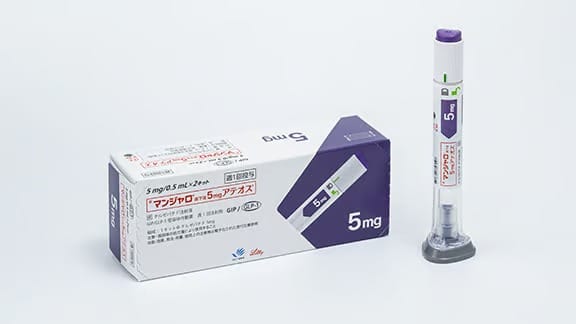
Patients frequently come in already comparing Mounjaro to other names they’ve encountered — Ozempic, Wegovy, Zepbound.
We don’t frame these as competitors with a winner.
We explain them the way we would in an exam room.
| Patients Often Ask… | Our Consultation Perspective |
| Why choose Mounjaro? | It acts on both GLP-1 and GIP receptors, and may be considered depending on a patient’s individual response and treatment goals. |
| What about Wegovy? | Wegovy is a GLP-1-only medication (semaglutide) and may suit patients with different needs or treatment history. |
| Is Ozempic the same? | Ozempic also contains semaglutide, but it’s approved for diabetes management, with weight loss as a secondary effect; treatment planning differs accordingly. |
| Is Zepbound different? | Zepbound shares tirzepatide, the same active ingredient as Mounjaro, but product availability and branding vary by country. |
There is no universally “better” option — suitability depends on the individual, and that’s exactly what a consultation is for.
Common Questions We Hear From International Patients
Q. Will I lose weight too quickly?
Weight loss pace varies significantly between individuals.
Physicians monitor progress and adjust dosing gradually — this is part of why titration starts low and increases over time, rather than beginning at a high dose.
Q. What happens if I experience side effects while traveling?
Mild gastrointestinal symptoms, like nausea or bloating, are relatively common, especially early in treatment or after a dose increase.
We advise patients on what to expect and when symptoms warrant contacting a doctor, whether in Japan or after departure.
Q. Can I continue treatment after returning home?
Often, yes, though it depends on medication access and physician approval in your home country.
We discuss this during consultation so patients aren’t left without a plan once they leave Japan.
Q. Will I regain weight if I stop?
This varies by individual, and it’s an honest conversation we have rather than a guarantee either way.
Sustainable results generally depend on how lifestyle habits evolve during treatment, not the medication alone.
Q. What if my weight-loss progress slows down?
Reaching a plateau is a normal part of many patients’ experience and doesn’t necessarily mean treatment has stopped working.
It’s usually a point where we reassess the plan together — dosing, habits, and expectations — rather than a sign to abandon treatment.
Conclusion
Mounjaro isn’t simply about receiving an injection—it’s about finding the right treatment plan for your health, goals, and lifestyle.
One of the first questions we ask isn’t, “How much do you want to lose?” It’s, “What has made weight management difficult for you until now?” The answer helps us understand not only whether Mounjaro is appropriate, but also how to support long-term, sustainable weight management.
If you’d like to learn more about Mounjaro treatment, including the consultation process, dosing, and pricing at BIANCA CLINIC, we invite you to explore our treatment page.