



People searching for midface lift before-and-after photos often want to know how much their cheeks may be lifted, whether under-eye sagging or nasolabial folds may become less noticeable, and how long recovery might take.
A midface lift is a surgical procedure that repositions soft tissue—including fat and muscle—around the central face, particularly the cheeks and lower eyelids.
The extent of change depends on your facial anatomy and skin condition, the surgical technique used, and whether other procedures are performed at the same time.
At BIANCA CLINIC in Tokyo, we tailor each midface lift procedure to the patient’s facial anatomy and aesthetic goals.
In this article, we explain what to look for in real patient before-and-after photos, how surgical techniques differ, and what to know about recovery and downtime.
How Does a Midface Lift Change Your Appearance After Surgery?

A midface lift targets the cheeks and the area under the eyes. By repositioning deep-layer soft tissue (fat and muscle), it can lift sagging cheeks and soften the transition from under the eyes to the cheeks.
Results vary with bone structure and the surgical plan, but you can generally look for changes in four areas:
- Cheek Position: Sagging cheek tissue may be repositioned to create a higher, more supported cheek contour.
- Under-Eye Area: The transition between the lower eyelid and cheek may appear smoother, creating a refreshed appearance around the eyes.
- Nasolabial Folds (Nasolabial Grooves): Nasolabial folds related to midface sagging may become less noticeable.
- Overall Facial Balance: As the position of the cheeks is corrected the face may appear more balanced and refreshed.
Please note that the final results vary from person to person depending on skin type, bone structure, the degree of sagging, and whether other procedures are performed in conjunction with this one.
When reviewing midface lift before and after photos, compare images taken from similar angles and with similar facial expressions. The time elapsed after surgery is also important.
Early photos may show swelling or bruising, while later photos can provide a clearer view of how the tissues have settled.
Midface Lift Before and After: Real Patient Cases at BIANCA CLINIC
Explore real midface lift before and after pictures from procedures performed at BIANCA CLINIC.
They show how the cheeks and the under-eye area may change after surgery. Individual results differ, and in a combined-procedure case the changes reflect all procedures performed.
Case 1 | Subperiosteal Midface Lift and Upper Eyelid Skin Excision
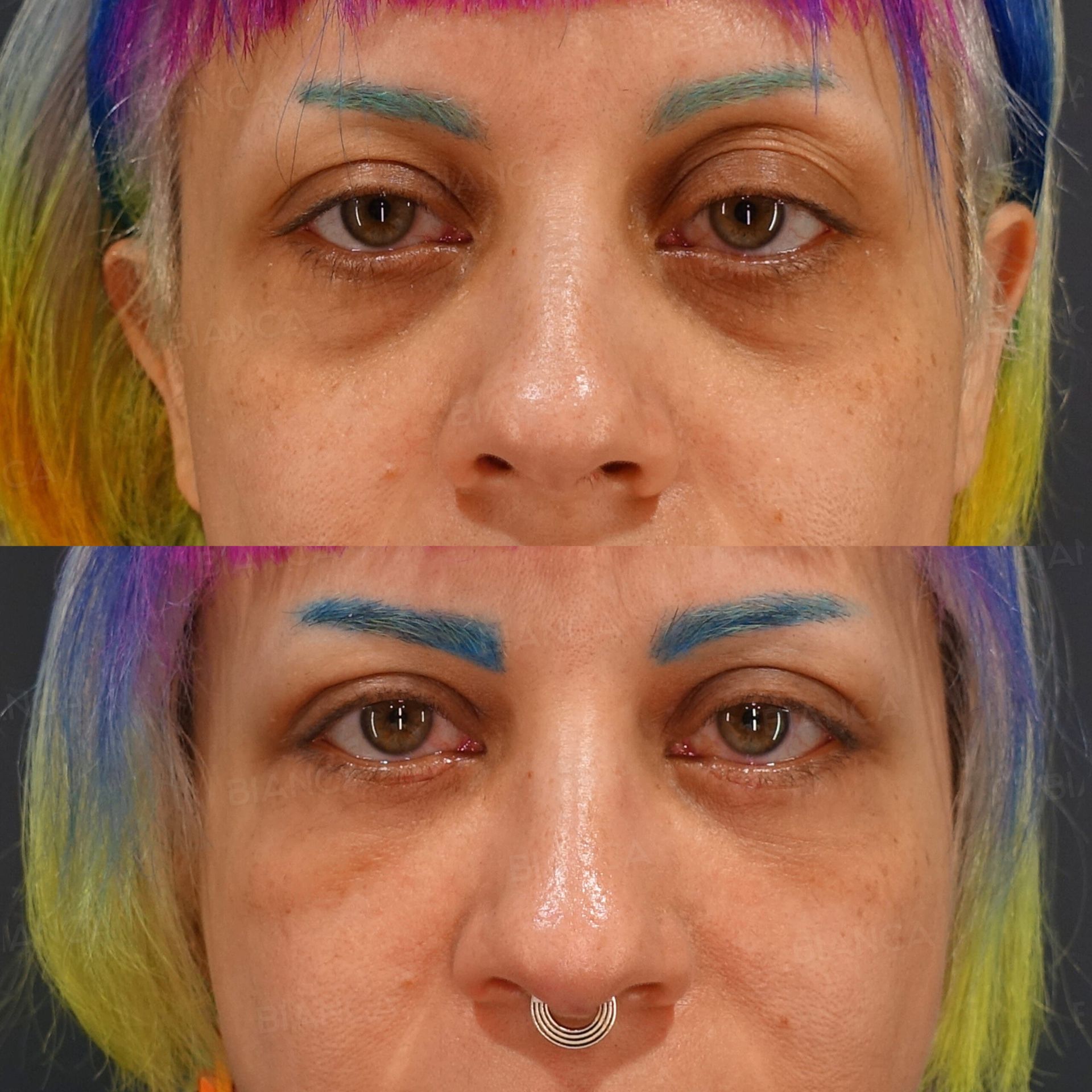
This patient underwent a subperiosteal midface lift combined with upper eyelid skin excision.
When reviewing the before-and-after photographs, we pay particular attention to the transition between the lower eyelid and upper cheek.
In the postoperative image, this area appears smoother, and the upper cheek contour looks more supported.
It is important to assess the result in the context of both procedures. Changes around the upper eyelids should not be attributed to the midface lift alone.
According to the treating surgeon’s case notes, the subperiosteal approach was used to elevate the descended cheek tissue vertically rather than pulling it toward the ears.
The upper eyelid skin excision was also planned conservatively to avoid removing excessive skin.
This case illustrates why evaluating the direction of tissue repositioning and the balance between procedures matters when interpreting midface lift before-and-after results.
The postoperative photograph was taken one month after surgery, when some swelling or firmness may still be present.
For this reason, it should be viewed as an intermediate stage of recovery rather than a definitive final result.
Possible Risks and Side Effects: Swelling, bruising, temporary numbness, asymmetrical healing, changes in lower eyelid position, scarring, and other surgical complications may occur.
Upper eyelid skin excision also carries its own risks, including dryness and difficulty closing the eyes. Individual risks should be discussed during consultation.
▶View More Midface Lift Before-and-After Results at BIANCA
Why Choose BIANCA CLINIC for a Midface Lift?
At BIANCA CLINIC in Tokyo, our midface lift approach offers three important features: a choice of supraperiosteal and subperiosteal techniques, the inclusion of the anterior Hamra method to address suitable under-eye concerns, and optional endoscopic assistance when appropriate.
We assess the degree of cheek sagging, lower eyelid anatomy, and your aesthetic goals before discussing which surgical technique and options may be suitable.
Our aim is to address the areas contributing to an uneven or descended midface contour rather than simply lifting the cheeks as much as possible.
Supraperiosteal vs. Subperiosteal Midface Lift
The main difference between these techniques is the tissue plane in which the surgeon works.
| Approach | How it works |
|---|---|
| Supraperiosteal | We release and lift cheek tissue above the periosteum, then secure it to the periosteum around the orbital rim. |
| Subperiosteal | We release tissue beneath the periosteum over the cheekbone, allowing wider dissection and firmer support of the repositioned cheek tissue. This approach may offer greater resistance to recurrent sagging over time. |
Neither technique is the right choice for everyone. The decision depends on individual anatomy and the intended surgical plan.
A midface lift generally takes approximately three hours, although the exact duration depends on the surgical plan.
Can a Midface Lift Also Address Under-Eye Bags?
At BIANCA CLINIC, the anterior Hamra method is included in our midface lift procedure.
This allows us to address suitable under-eye concerns and descended cheek tissue during the same operation.
The anterior Hamra method repositions protruding orbital fat to help smooth under-eye bulges and hollows.
Because it uses an incision along the lower eyelash line, the same incision can also provide access for the midface lift.
However, not every type of under-eye fullness can be corrected through surgery.
We assess the lower eyelids and surrounding tissues to determine which approach is appropriate.
When Is Endoscopic Assistance Used During a Midface Lift?
At BIANCA CLINIC, endoscopic assistance is available as an optional addition to a midface lift.
An endoscope provides a magnified view of the surgical area, which may help us visualize anatomical structures during selected steps of the procedure.
We assess whether this option is appropriate based on your facial anatomy and surgical plan.
Midface lift pricing at BIANCA CLINIC starts at ¥808,500 (tax included), while the subperiosteal approach is listed at ¥990,000 (tax included).
Additional procedures and optional endoscopic assistance may affect the total cost.
Please refer to our treatment page for current pricing and details.
▶Explore BIANCA’s Midface Lift Techniques and Treatment Options
How Long Is Recovery After a Midface Lift?

If you are considering a midface lift, you may be wondering how much downtime to expect and when you can return to your usual activities.
Because a midface lift involves surgical incisions, temporary swelling and bruising are common.
These symptoms generally improve as healing progresses, although recovery varies between individuals.
Below, we explain the general recovery timeline and postoperative care guidance at BIANCA CLINIC.
Midface Lift Recovery Time: What to Expect
Recovery varies from person to person. BIANCA CLINIC provides the following general timeline for midface lift surgery.
| Recovery milestone | General guideline |
|---|---|
| Swelling and bruising | Often improve within approximately 2 weeks |
| Other postoperative symptoms | May take approximately 1 month to settle |
| Compression | Gauze and bands for 3 days; additional taping may be needed for 1 week or longer |
| Ointment and eye drops | Approximately 1 week |
| Suture removal | Around day 7 |
| Eye makeup and contact lenses | Avoid for 1 week |
| Midface contour becomes more settled | Approximately 2–3 months |
The incision is generally placed along the lower eyelash line, where the scar tends to become less noticeable as healing progresses.
However, scar visibility and recovery vary depending on individual healing, the surgical technique, and any additional procedures.
At BIANCA CLINIC, face washing and makeup—excluding the eye area and surgical site—can generally be resumed the day after surgery.
Please follow your surgeon’s individual aftercare instructions.
When Should I Plan My Post-Surgery Travel and Return Home?
If you are traveling to Japan for surgery, it is important to plan your stay around postoperative appointments and your expected recovery.
When planning your trip, we recommend considering the following points:
- The length of your stay in Japan
- Postoperative follow-up and examination schedule (e.g., when sutures will be removed)
- Support system for consulting a doctor if you experience any concerning symptoms after returning home
Your return date should not be based solely on when swelling is expected to improve.
Before booking your return flight, we recommend discussing your treatment plan, postoperative appointments, and recovery needs with us so that you can plan your stay in Japan accordingly.
At BIANCA CLINIC, interpretation and counseling services are complimentary, and foreign currency estimates are available upon request.
Some doctors may require an additional selection fee.
You can explore our Midface Lift treatment page to review the available techniques, pricing, and recovery information before arranging a consultation.
▶Check Midface Lift Recovery and Treatment Details
FAQ

How effective are midface lifts compared to non-surgical alternatives?
A midface lift can reposition deeper cheek tissues more directly than non-surgical treatments, making it an option for people seeking more substantial correction of midface sagging.
Non-surgical treatments, such as thread lifts and injectable treatments, may be suitable for those who prefer less invasive approaches, but the extent and duration of change vary by treatment and individual anatomy.
The most appropriate option depends on the cause of sagging, your aesthetic goals, and how much downtime you can accommodate.
At BIANCA CLINIC, we assess your facial anatomy, treatment goals, and recovery preferences to help you understand the benefits and limitations of each approach.
How long do midface lift results last?
Unlike temporary treatments such as hyaluronic acid injections, a midface lift surgically repositions and secures deeper tissues, including fat and fascia, to provide potentially long-lasting improvement.
However, a midface lift does not stop the natural aging process.
Even after surgery, which restores a more youthful appearance, changes associated with the passage of time will continue to progress gradually.
Therefore, the duration of the effects and the course of recovery vary from person to person.
Will my face look unnatural after a midface lift?
The appearance after surgery depends on your anatomy, the surgical plan, and how the tissues heal.
A temporary pulling sensation may occur and gradually become less noticeable.
If you’ve had facelift surgery before, tell your surgeon, as your surgical history may influence the treatment plan and postoperative experience.
Can a midface lift improve both under-eye bags and nasolabial folds?
A midface lift repositions descended cheek tissue and may help make nasolabial folds related to midface sagging less noticeable.
At BIANCA CLINIC, the anterior Hamra method is included in our midface lift procedure, allowing us to address suitable under-eye concerns and descended cheek tissue during the same operation.
The degree of improvement depends on the underlying causes of each concern and your individual treatment plan.
When Can I Expect My Final Midface Lift Results?
You can generally assess your midface lift results more accurately around two to three months after surgery, when swelling has subsided and the tissues have had more time to settle.
At one month after surgery, some swelling or firmness may still remain, so the results may not yet reflect the final appearance.
Recovery varies by individual, and it may take longer for the tissues to settle fully.
How Do I Choose a Qualified Surgeon for a Midface Lift?
When choosing a surgeon for a midface lift, review their qualifications, experience with facial rejuvenation surgery, and approach to treatment planning.
Before-and-after photos can help you assess their work, but look for cases with similar concerns and check whether additional procedures were performed.
It is also important to understand the proposed surgical technique, expected recovery, potential risks, and total cost before making a decision.
A reputable surgeon should explain both the potential benefits and limitations of surgery, answer your questions clearly, and recommend a treatment plan based on your anatomy and goals rather than promising a specific outcome.
At BIANCA CLINIC, we discuss the expected benefits, limitations, risks, and recovery requirements before recommending a surgical plan tailored to your anatomy and goals.
Midface lift before-and-after photos can help you understand the changes surgery may achieve, but they cannot predict your individual result.
At BIANCA CLINIC, we assess your cheek position, lower eyelid anatomy, and treatment goals before discussing whether a midface lift may be appropriate.
If you are considering surgery in Tokyo, explore our Midface Lift treatment page to review the available techniques, recovery guidance, and consultation options.
▶Explore Midface Lift Treatment and Consultation Options at BIANCA