




What Is Filler? Dermal filler is an injectable treatment used to restore volume, refine facial contours, and soften selected lines and hollows.
But choosing filler is not simply about adding volume.
At BIANCA CLINIC, we look at the treatment area, facial structure, desired degree of change, and the patient’s previous treatments before recommending an approach.
For international patients visiting Tokyo, treatment timing and recovery also need to fit the travel schedule.
What Is Filler and What Is It Used For?

What is dermal filler?
Dermal filler is an injectable material that is injected into or beneath the skin to restore volume, improve contours, or soften selected lines and hollows.
Depending on the treatment area, you may hear terms such as lip filler, cheek filler, eye filler, under-eye filler, jawline filler, jaw filler, nose filler, or wrinkle filler.
These terms generally describe where or why filler is being used.
They do not necessarily refer to different types of filler.
For example, filler may be considered for lips that have naturally limited volume, cheeks that have lost volume, or a chin and jawline that could benefit from greater definition.
Some patients also ask about nasolabial filler for the folds beside the nose and mouth, or jowl filler for concerns around the lower face.
Filler can also be used in areas outside the face, including the hands in selected cases.
The appropriate product and technique depend greatly on the treatment area.
What is filler made of?
Many commonly used dermal fillers are made with hyaluronic acid (HA).
If you have searched “what is filler hyaluronic acid” or “what is filler made of hyaluronic acid,” this is generally what those searches are referring to.
HA is a substance naturally found in the body and is formulated into an injectable gel for aesthetic use.
Different HA fillers have different physical properties, allowing physicians to consider factors such as softness, flexibility, and structural support when selecting a product.
Not all fillers are made from HA. Radiesse, for example, is made with a different type of material and has a different mechanism of action.
It therefore should not simply be considered another brand of HA filler.
Filler is not the same as every injectable treatment
Another common source of confusion is the word “injectable.”
- Dermal filler: primarily used to add volume, support, or structure.
- Botulinum toxin: works by reducing targeted muscle activity. Xeomin is a botulinum toxin product, so “Xeomin filler” is not technically the correct term.
- Collagen-stimulating injectables: are intended to encourage a gradual tissue response. Products such as Juvelook may fall into this category, depending on the formulation and treatment approach.
Knowing the difference matters because a concern may not always require a volume-adding treatment.
How Do Doctors Choose the Right Filler?

The product name is only one part of the decision
At BIANCA CLINIC, we offer a range of dermal fillers, including products from different filler lines such as Juvederm, NEAUVIA, Restylane, and RHA.
Patients may also come to us having researched specific products such as Voluma, Volbella, or Volux.
RHA is one of the filler options available at BIANCA CLINIC, with different formulations such as RHA 1 to RHA 4.
As with any filler, the appropriate option depends on the treatment area, tissue characteristics, facial movement, and the patient’s goals.
During a consultation, a physician may consider:
- The treatment area
- Skin and tissue characteristics
- Facial proportions
- The desired degree of change
- Previous filler or injectable treatments
- The physical properties of the product
- Overall facial balance
For example, questions such as “what is Voluma filler?” or “what is Volbella filler?” concern specific Juvederm products with different characteristics.
The same principle applies to RHA fillers: RHA 1, RHA 2, RHA 3, and RHA 4 have different characteristics and may be considered for different treatment needs.
The more useful question is not simply which product has the strongest reputation online.
It is whether its characteristics fit your anatomy, treatment area, and goals.
How is filler measured?
Filler is usually measured by volume.
Patients may hear terms such as 0.5 mL, 1 mL, 2 mL, 1 syringe, or 1 cc. In practical terms, 1 cc is equivalent to 1 mL.
However, the amount of filler does not tell the whole story.
For example, 0.5 mL lip filler may be appropriate for one patient, while another may have different needs based on lip shape, proportions, or previous treatment.
The same applies to 1 mL or 2 mL of filler.
There is no fixed answer to “how much filler do I need?” A physician needs to consider both the amount of product and where it will be placed.
In some cases, carefully selected injection points are more important than simply increasing the volume.
Why facial balancing can matter
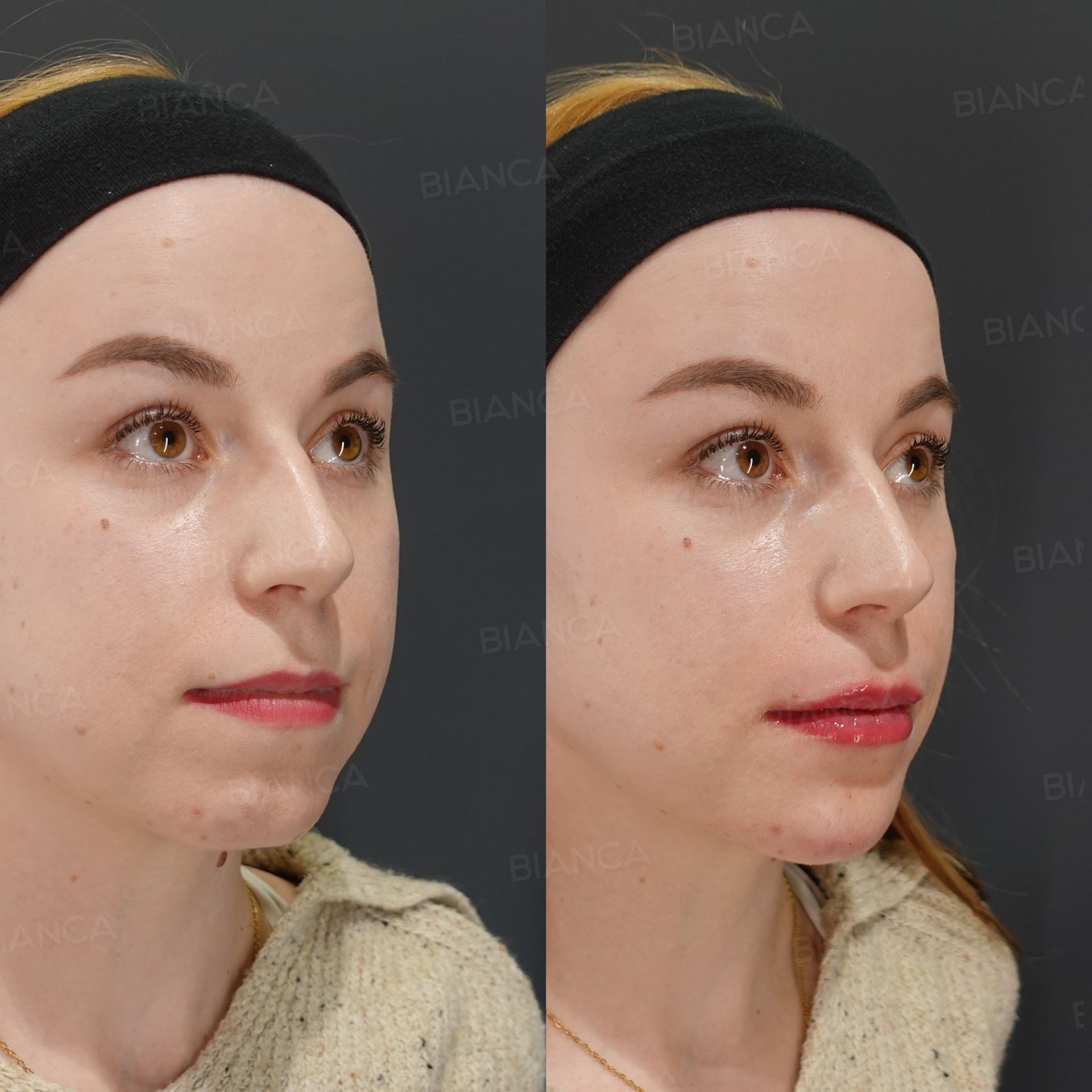
Facial concerns rarely exist completely on their own.
A line or hollow may also be influenced by surrounding volume and overall facial structure.
For example, a patient concerned about nasolabial folds received hyaluronic acid filler to the nose, alar base, nasolabial folds, and chin.
Rather than focusing on the folds alone, the treatment plan considered the support and proportions of the surrounding areas.
The chin was then assessed as part of the overall facial profile.
This is why facial balancing can matter.
Whether considering cheek filler, chin filler, or jawline filler, looking at the face as a whole can help determine whether treating one area alone is appropriate.
At BIANCA CLINIC, our OMAKASE FILLER approach considers individual facial structure and concerns when determining where filler may be appropriate.
Our Total Facial Treatment concept similarly considers facial proportions across multiple areas when indicated.
Filler is not always about filling the line that bothers you most.
Sometimes the more useful question is what is contributing to that concern.
▶Explore Personalized Filler Treatment
What Results and Risks Should You Know Before Treatment?

When will you see the final filler result?
A change may be visible immediately after filler treatment, but the appearance at the end of the appointment should not automatically be considered the final result.
Swelling, redness, tenderness, and bruising can temporarily affect the treated area.
The time required for these effects to settle varies according to the treatment area, product, injection technique, and individual response.
This is particularly relevant for international patients who may have photographs, meetings, or events planned during their stay in Japan.
It is worth discussing the expected recovery period before deciding when to schedule treatment.
What are common filler side effects?
Common short-term effects may include:
- Swelling
- Bruising
- Redness
- Tenderness
- Temporary lumps or unevenness
These effects can be more noticeable in certain areas, such as the lips or under-eye area.
Individual responses vary, so patients should contact their treating clinic if they have concerns about an unexpected or persistent change.
What about filler migration, granuloma, or blindness?
Patients researching filler may come across terms such as filler migration, filler granuloma, and filler blindness.
These refer to different and generally uncommon complications, but they are worth understanding before treatment.
Migration describes filler moving beyond its intended treatment area.
A granuloma is an inflammatory response that may result in a persistent lump or nodule.
More serious vascular complications can occur if filler affects a blood vessel, potentially causing tissue injury or, in rare cases, vision-related complications.
This is one reason filler should be approached as a medical procedure.
Appropriate product selection, knowledge of facial anatomy, injection technique, and appropriate management of complications all form part of responsible treatment.
Can filler be dissolved?
Some hyaluronic acid fillers can be dissolved with hyaluronidase when medically appropriate.
This is why you may encounter terms such as “filler dissolver,” “lip filler dissolving,” or “lip filler removal.”
However, dissolving filler is not automatically necessary when a patient dislikes the appearance immediately after treatment.
Swelling and bruising can temporarily change the shape of the treated area.
If you are concerned about previous filler, a physician should first determine whether the issue is temporary swelling, product placement, an aesthetic concern, or a medical complication.
The appropriate next step depends on that assessment.
Is Filler Right for You? What International Patients Should Consider

Who may benefit from filler?
Filler may be considered for concerns such as:
- Facial volume loss
- Selected lines or hollows
- Cheek or temple volume
- Lip shape or volume
- Chin or jawline definition
- Facial proportions and balance
The desired result can be subtle.
Some patients want to restore volume that has changed with age, while others are interested in refining a specific feature.
When filler may not be the first choice
Not every wrinkle or contour concern needs filler.
If a concern is mainly related to muscle activity, botulinum toxin may be considered.
Significant skin laxity may call for a different treatment approach, while concerns focused on skin quality may be addressed with other aesthetic treatments or injectables.
In some situations, surgery may also be considered when there is substantial tissue or structural change.
This is an important part of a physician-led consultation: filler should have a clear purpose.
If another treatment is more appropriate for the concern, that should be discussed before treatment begins.
Planning filler treatment during a trip to Japan
For international patients, treatment timing is an important part of the consultation.
Before scheduling filler during a trip to Tokyo, consider:
- The length of your stay
- Whether you need consultation before treatment
- Possible swelling or bruising
- Photos, meetings, or events during your trip
- Your return flight
- Whether follow-up will be possible after returning home
BIANCA CLINIC provides language support for international patients, and treatment planning can take travel schedules into consideration.
If you are staying in Japan for only a few days, tell your physician about your itinerary before treatment.
This can help determine whether the timing is appropriate and whether you have enough time to monitor the treated area before flying home.
Why physician expertise matters
Filler treatment requires more than knowing where an injection can be placed.
Physicians need to consider facial anatomy, proportions, product characteristics, injection depth and location, previous treatments, and potential complications.
BIANCA CLINIC has treated patients from more than 95 countries and reports more than 150,000 patients and 1.5 million cases across its services.
These figures reflect the clinic’s overall experience and should not be taken as a guarantee of any individual result.
For each patient, the important part of consultation is connecting the patient’s concerns with an appropriate treatment plan.
This includes deciding whether to inject, where to inject, what to use, and how much to use.
Frequently Asked Questions
What is the difference between filler and dermal filler?
In aesthetic medicine, “filler” and “dermal filler” generally refer to the same type of injectable treatment.
Dermal fillers are placed in or beneath the skin to add volume, provide structural support, or soften selected lines and hollows.
“Filler” is simply the shorter term commonly used by patients and clinics.
What is hyaluronic acid filler?
Hyaluronic acid filler is a dermal filler made with hyaluronic acid formulated into an injectable gel.
Different HA fillers have different physical properties, so the appropriate product depends on the treatment area, tissue characteristics, desired degree of change, and physician assessment.
How much filler do I need?
There is no standard amount that applies to everyone.
Filler may be discussed in quantities such as 0.5 mL, 1 mL, or 2 mL, but the amount alone does not predict the result.
A physician should assess your facial structure and goals before deciding whether filler is appropriate and how much product may be needed.
Can filler be dissolved if I do not like the result?
Some HA fillers can be dissolved with hyaluronidase when medically appropriate.
However, early swelling can temporarily affect the appearance, so immediate dissatisfaction does not necessarily mean the filler needs to be removed.
A medical assessment should come first.
Is filler safe for international patients visiting Tokyo?
International patients can consider filler treatment in Tokyo, but careful medical assessment remains important.
Your medical history, previous filler, facial anatomy, treatment goals, and travel schedule should all be considered.
Allowing sufficient time before your return flight can also make it easier to monitor the treated area and seek follow-up if needed.
Conclusion
What is filler? It is an injectable treatment that can restore volume, refine contours, and address selected facial concerns.
The right choice depends on your facial structure, goals, and the area being treated.
At BIANCA CLINIC, physicians assess these factors to create an individualized treatment plan.
If you are considering filler in Japan, a consultation is a good place to start.