

| Reverse Hamra Method | ¥632,800 (tax incl.) |
|---|---|
| Total | ¥632,800 (tax incl.) |
*Pricing is an example. Final cost is determined during consultation.
| Reverse Hamra Method | ¥632,800 (tax incl.) |
|---|---|
| Total | ¥632,800 (tax incl.) |
*Pricing is an example. Final cost is determined during consultation.
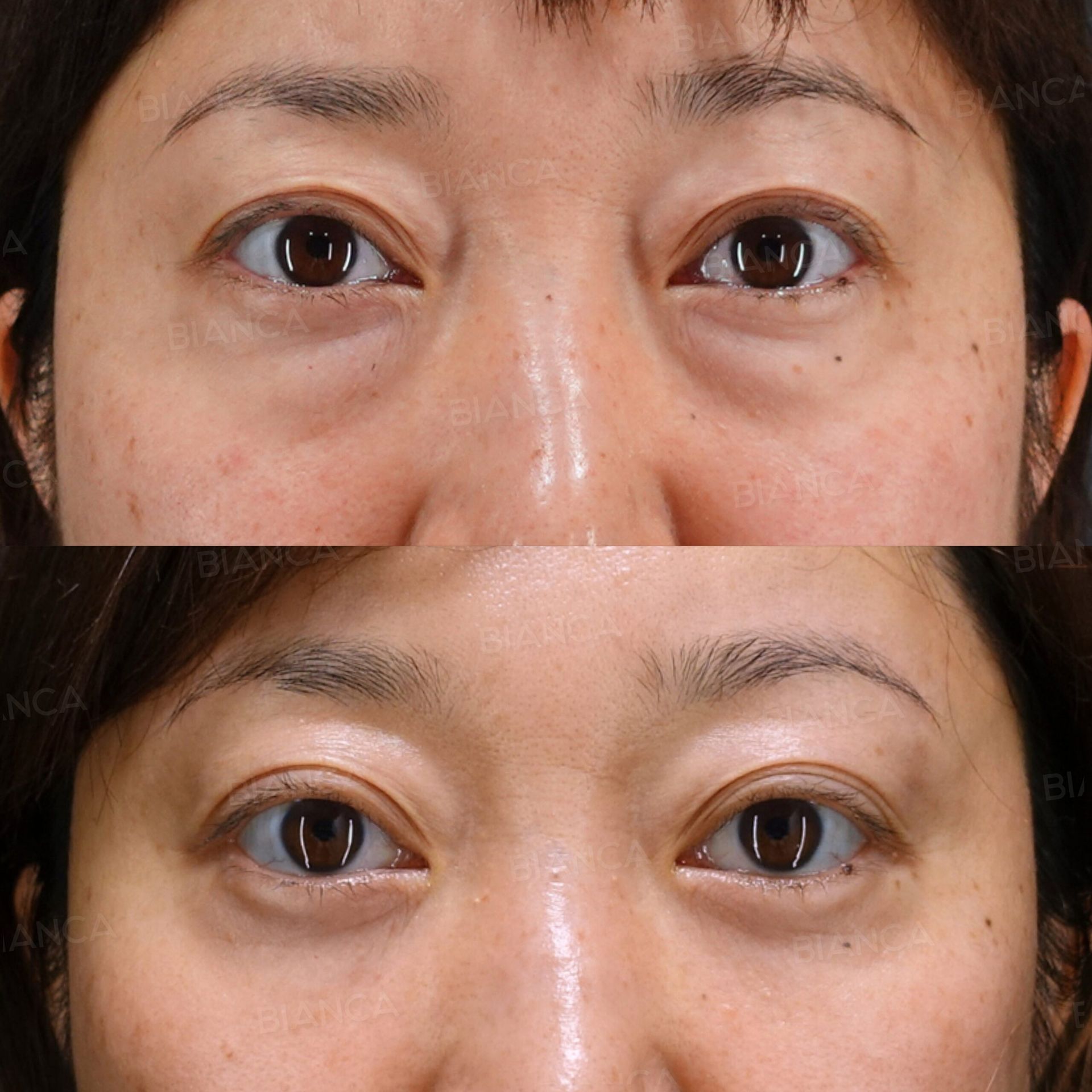
Treatment details: Under-Eye Dark Circle & Sagging Removal (Reverse Hamra Method)
The reverse Hamra method is a procedure suitable for under-eye sagging or dark circles, especially those accompanied by unevenness (so-called “shadowed dark circles”). By incising the inside of the eyelid and repositioning and fixing excess orbital fat, the method aims to correct both bulging and hollowing simultaneously. Unlike simple fat removal, which carries the risk of worsening hollowness, this method allows fat to be used to fill depressions. The reverse Hamra method involves an incision through the inner eyelid (conjunctiva), without removing excess skin.
Because the skin surface is not incised with the reverse Hamra method, downtime is relatively short (about 1 week). The reverse Hamra method approaches from the inner eyelid (conjunctival side), meaning no external stitches are used and suture removal is generally unnecessary. Swelling generally peaks 2 to 3 days after surgery and gradually improves within a week. Bruising usually fades in about 10 days. The conjunctiva may become red and can swell into a clear blister that takes days to weeks to settle. Double vision from swelling of the eye muscles can occur and is expected to be temporary. Contact lens use is generally possible about 1 week after surgery. However, if there is redness or discomfort, consult your doctor before wearing contact lenses again. Aging and lifestyle habits may cause sagging to reappear over time. Undercorrection, residual hollowing, asymmetry, or downward pull of the lower lid can require revision. The reverse Hamra method is thought to have a lower risk of ectropion (outward turning of the eyelid) compared to the Hamra method.