



Non-incisional double eyelid surgery creates a crease using sutures and generally involves less downtime.
Incisional surgery creates the crease through an incision and allows tissue adjustments when needed.
Non-incisional surgery may suit patients who prioritize less downtime and do not require substantial skin or tissue adjustment, while incisional surgery may be considered when excess skin or tissue needs to be addressed or a longer-lasting crease is desired.
The right choice depends on your eyelid anatomy, desired crease, and recovery preferences.
If you are comparing incisional vs non-incisional double eyelid surgery before traveling to Japan, you may already have a preference.
Perhaps you want the quickest recovery, or you would rather choose a method intended for longer-lasting results.
Those priorities matter, but they need to be considered alongside what your eyelids can support.
At BIANCA CLINIC in Tokyo, the choice is not limited to a simple “incisional or non-incisional” decision.
Our double eyelid surgery options include 2-point and 4-point non-incisional techniques, B TWICE hidden-suture surgery, natural adhesion surgery, and incisional surgery.
During consultation, your eyelid anatomy and preferred crease design are assessed, and simulation is used to help visualize and refine the desired outcome.
▷Explore BIANCA CLINIC’s Double Eyelid Surgery Options
How Do Incisional and Non-Incisional Double Eyelid Surgery Compare?
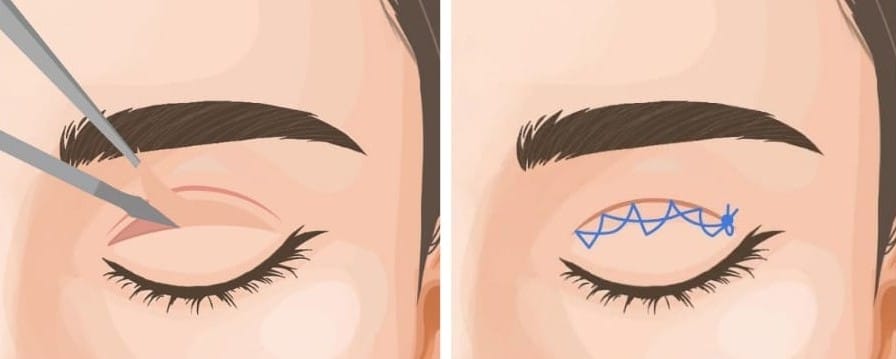
Both approaches create or refine an upper eyelid crease.
Their main difference is how the crease is formed and whether the procedure allows underlying tissue or excess skin to be adjusted.
Comparing these features can help you understand the trade-offs before discussing your individual suitability.
| What you want to compare | Non-incisional surgery | Incisional surgery |
| How the crease is created | Sutures establish the fold | An incision allows crease formation and tissue adjustment |
| Excess skin | Conventional non-incisional techniques do not involve skin excision. | Can be addressed when appropriate |
| Восстановление | Generally shorter | Generally longer |
| Долголетие | The crease may weaken or disappear | Intended for longer-lasting crease formation |
| Revision | Revision or reversal may be considered depending on the individual case. | Revision can be more involved |
| Main trade-off | Less tissue disruption, with limits to what sutures can achieve | More scope for adjustment, with an incision and longer healing |
Neither method guarantees a particular appearance.
Both are surgical procedures, and “non-incisional” does not mean non-surgical.
A useful consultation question is: “What would each method achieve on my eyelids, and what would it leave unchanged?” That gives you a more meaningful comparison than simply asking which procedure is better.
Which Method Suits Your Eyelid Thickness and Excess Skin?

Your eyelid anatomy and the change you want should be assessed together.
During consultation, the doctor assesses factors such as skin thickness, fat volume, skin laxity, and overall eyelid structure before recommending a technique.
Understanding whether your concern involves crease definition, tissue bulk, or excess skin helps explain why one approach may be more suitable than another.
Can a Suture Technique Create the Crease You Want?
Non-incisional double eyelid surgery may be considered when the eyelid does not require substantial skin removal or tissue adjustment.
The assessment needs to consider your eyelid condition alongside the crease you want.
For example, a request for a subtle fold and a request for a noticeably wider fold are different design goals.
Even on the same eyelid, they may raise different questions about support and stability.
Bring reference photographs, but explain what you like about them.
Is it the visible width, the inner corner, or how the crease looks without makeup? A photograph becomes more useful when it helps identify a specific preference.
When Might an Incisional Approach Be Considered?
Incisional surgery may be considered when excess skin or tissue bulk needs to be addressed.
Eyelid thickness, fat volume, and skin laxity are separate factors that should be assessed during consultation.
For patients researching double eyelid surgery for hooded eyes, the important question is whether creating a crease alone would address the concern.
The eyelid crease and the skin that hangs over it are related, but they are not the same issue.
Ask your doctor to explain what is contributing to the appearance you want to change.
If a procedure can define the crease but cannot sufficiently address the overlying skin, you should understand that limitation before proceeding.
BIANCA’s available options include conventional 2-point and 4-point suture techniques, B TWICE hidden-suture surgery, natural adhesion surgery, and incisional surgery.
Discussing these double eyelid surgery methods allows the consultation to move beyond a simple “cut or no cut” choice.
▷Compare BIANCA’s Double Eyelid Surgery Methods
Can Both Methods Create Your Preferred Double Eyelid Design?

Choosing a surgical method also means discussing the crease you hope to achieve.
Crease width, shape, and the features you want to preserve should be considered alongside your eyelid anatomy, rather than decided from a procedure name alone.
Does a Wider Crease Always Require an Incision?
A wider crease does not automatically determine the surgical method.
The design must be assessed alongside the eyelid’s structure.
“Wide” also needs clarification.
You may be referring to the line marked on a closed eyelid, or the strip of eyelid visible when your eyes are open.
Those descriptions do not necessarily communicate the same target.
During your consultation, ask to see how the proposed design relates to the appearance you want with your eyes open.
Explain whether you prefer a subtle change or a more noticeable crease, and identify any existing feature you want to preserve.
How Can Simulation Help at BIANCA?
BIANCA uses pre-treatment simulation to discuss and refine the desired outcome.
This provides a starting point for talking about crease width, shape, and facial balance.
Use that discussion to be specific.
Instead of saying only “I want natural eyes,” you might say, “I would like a visible crease without making the fold look much wider,” or “I want to keep the shape near the inner corner.”
Simulation is a communication tool, rather than a guarantee of the final result.
Ask what the simulation can illustrate and what it cannot predict, including changes that occur during healing.
Choosing the technique and choosing the design should be connected conversations.
Knowing the name of the procedure is not enough if you and your doctor have different expectations about the desired change.
What Can BIANCA’s Before-and-After Case Show You?
Before-and-after photographs can help you describe the change you want, but their meaning depends on the procedure and when the photographs were taken.
BIANCA’s B TWICE case offers a starting point for discussing both crease design and the appearance immediately after surgery.
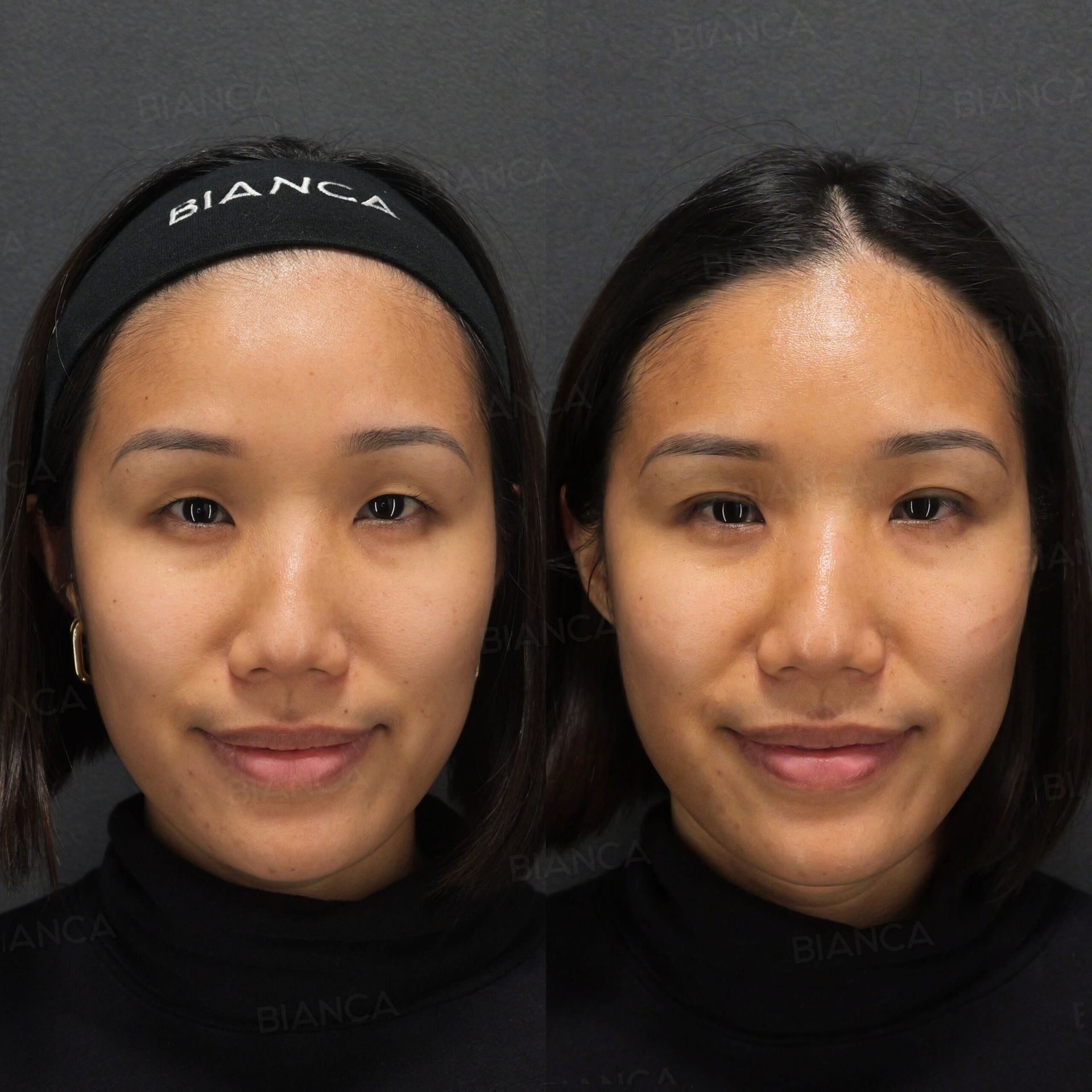
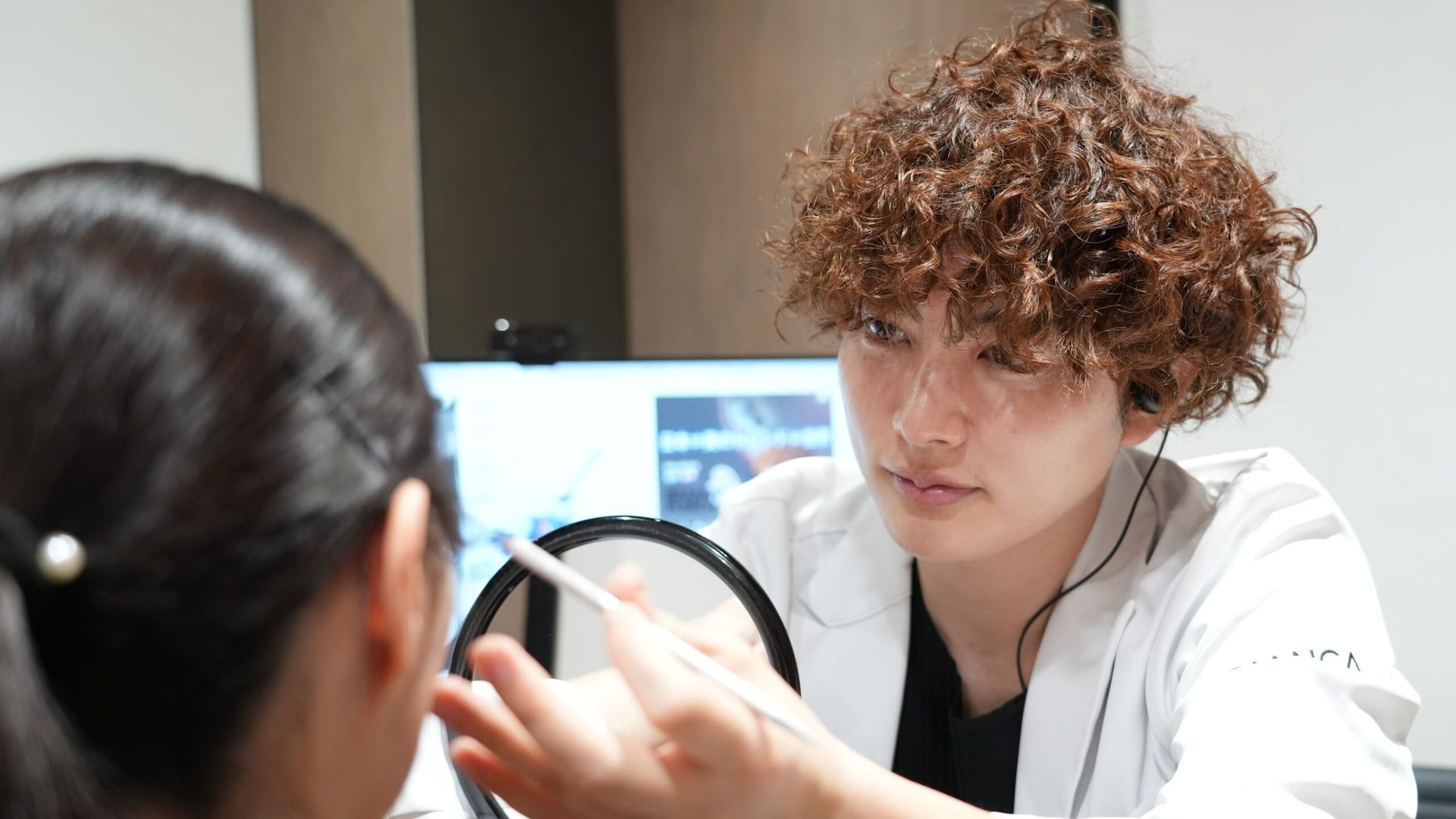
The published case was performed by Dr. Yukitaro Ikeda.
In his accompanying explanation, he describes the sutures as being placed from the inner side of the eyelid and notes that the crease appears higher and more defined immediately after treatment.
The case page describes further settling over the following weeks.
This makes the photograph useful for discussing an important point: the crease you see immediately after surgery should not be treated as the final width.
If you are considering a similar crease design, the important question is not whether you can reproduce another patient’s result, but which technique is appropriate for your own eyelid anatomy and goals.
However, the photograph does not explain why B TWICE was selected for this patient, predict your own recovery, or show that this method would produce a better result than incisional surgery for another patient.
When reviewing cases, first check the procedure name and how long after surgery the postoperative photograph was taken.
Then identify what you want to discuss: the visible crease, its shape near the inner corner, or the degree of change.
A productive question is, “Which features of this result might be achievable for me, and which depend on this patient’s starting anatomy?” That turns a before-and-after photograph into a consultation aid.
▷View BIANCA’s Double Eyelid Surgery Options
How Should Recovery and Longevity Affect Your Travel Plans?

When planning surgery during a visit to Japan, consider both the recovery period and your expectations for how long the crease may last.
Your itinerary should allow for the proposed procedure, postoperative care, and the possibility that your appearance will continue to change after you return home.
When Will the Crease Look Settled?
Visible healing and final settling are different milestones.
A person may feel ready to resume some activities while the crease continues to change.
Non-incisional methods generally involve less downtime than incisional surgery, but a shorter recovery does not mean there will be no visible swelling.
Both approaches can involve temporary swelling, bruising, or discomfort during recovery.
Ask about the risks relevant to the proposed technique, including suture-related problems for non-incisional surgery and scar-related concerns for incisional surgery.
If your trip includes a photo shoot, wedding, or important meeting, let your doctor know the dates before scheduling treatment.
Describe how comfortable you would be with visible swelling rather than asking only when you can “go out.”
Should a Short Stay Decide the Method?
Your travel dates should inform planning, but they should not override suitability.
If the appropriate treatment does not fit your available recovery time, changing the timing may be preferable to choosing an unsuitable procedure.
Before booking flights around surgery, ask:
- Will I need an in-person postoperative review or suture removal?
- What should happen before I return home?
- When can I resume eye makeup and contact lenses?
- How should I contact the clinic if a concern develops after departure?
Confirm the answers for your actual procedure.
Instructions for one non-incisional technique should not be assumed to apply to every double eyelid operation.
For double eyelid surgery in Tokyo, your consultation should help you connect the proposed treatment with a realistic visit schedule.
BIANCA CLINIC welcomes international patients seeking double eyelid surgery in Japan, with English-language support available.
Your consultation can also take your travel schedule into account when discussing the treatment plan.
FAQs About Incisional vs Non-Incisional Double Eyelid Surgery
Questions about longevity, previous eyelid surgery, and recovery often come up when comparing these approaches.
The answers below provide a starting point for discussing your eyelid condition and the specific technique being considered.
Q. Which Is Better: Incisional or Non-Incisional Double Eyelid Surgery?
Neither method is better for everyone.
Non-incisional surgery generally involves less downtime and may be suitable when substantial skin or tissue adjustment is not required.
Incisional surgery allows greater tissue adjustment and is intended for longer-lasting crease formation.
The more appropriate option depends on your eyelid anatomy, desired crease design, recovery preferences, and treatment goals.
Q. How Long Does Non-Incisional Double Eyelid Surgery Last?
There is no single duration that applies to every patient.
A crease may remain stable or weaken over time.
Ask how your eyelid condition and proposed design affect the likelihood of needing another procedure.
Q. Does Incisional Surgery Guarantee a Permanent Result?
No technique guarantees an unchanged appearance for life.
Incisional surgery is intended to produce a lasting crease, but long-term appearance and the possibility of revision should still be discussed.
Q. Can I Switch to Incisional Surgery After a Suture Procedure?
It may be possible, depending on your current eyelid condition and previous surgery.
Tell your doctor what was performed, when it was done, and whether sutures were removed or additional procedures were undertaken.
Q. Is Natural Adhesion Surgery the Same as a Conventional Suture Method?
The techniques differ.
BIANCA offers natural adhesion surgery alongside other methods.
Ask how its crease formation, suitability, and recovery instructions compare with the particular alternative being considered.
Q. Does Uneven Swelling Mean My Final Result Will Be Asymmetric?
Early differences in swelling do not by themselves establish the final outcome.
Follow your review schedule and contact the clinic about concerning changes.
Discuss Your Preferred Design at BIANCA CLINIC
You do not need to decide between incisional and non-incisional surgery before your visit.
At BIANCA CLINIC, your eyelid anatomy, preferred crease design, recovery preferences, and travel schedule can all be considered when discussing the most appropriate option for you.