



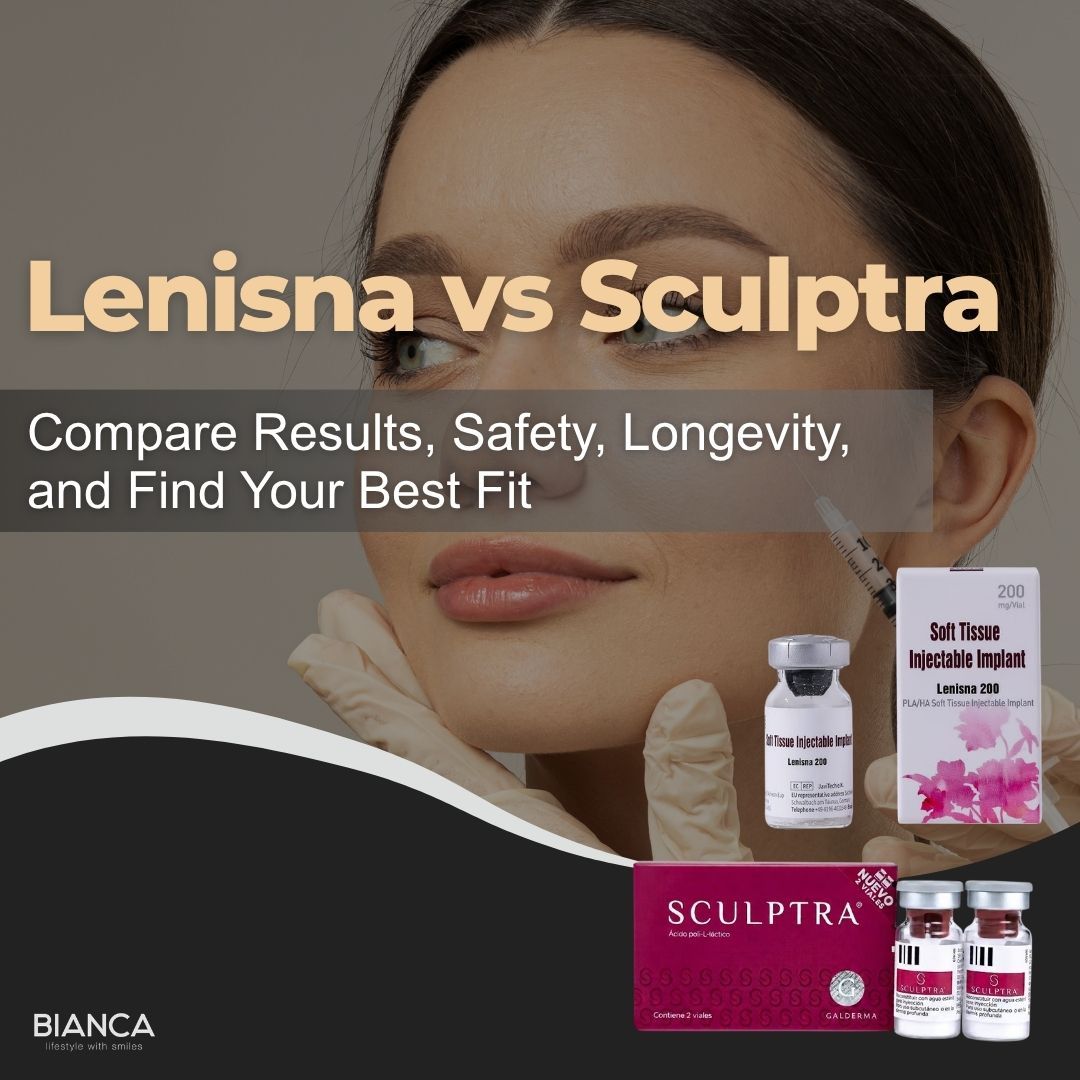
Lenisna vs Sculptra is a common comparison for anyone exploring collagen-stimulating injectables.
But which treatment is better suited to restoring lost facial volume without creating an overly full appearance?
Both are injectable collagen biostimulators designed to stimulate your body’s natural collagen production.
The main difference is their formulation: Lenisna (Juvelook Volume) combines poly-D,L-lactic acid (PDLLA) with non-cross-linked hyaluronic acid, while Sculptra uses poly-L-lactic acid (PLLA).
Both may help address facial volume loss through gradual collagen stimulation, but neither is universally better.
The most suitable option depends on your facial anatomy, the areas you want to treat, your desired results, and your treatment schedule.
In this article, we compare Lenisna and Sculptra in terms of results, longevity, and safety, while explaining the factors that guide treatment selection at BIANCA CLINIC in Tokyo, Japan.
Lenisna vs Sculptra: What Are the Main Differences?

Both Lenisna and Sculptra work by encouraging collagen production, but they are not interchangeable.
The type of polylactic acid used—and how each product is formulated—sets them apart.
Differences in Ingredients, Mechanisms of Action, and Expected Results
Lenisna, also known as Juvelook Volume, combines poly-D,L-lactic acid (PDLLA) with non-cross-linked hyaluronic acid (HA).
Sculptra, on the other hand, contains poly-L-lactic acid (PLLA), a biodegradable substance used to stimulate collagen production.
Both treatments work by encouraging collagen formation within the treated tissues, leading to gradual changes over time.
However, their particle characteristics, preparation methods, and available clinical evidence are not identical.
| Comparación | Lenisna (Juvelook Volume) | Sculptra |
| Main ingredients | PDLLA + non-cross-linked HA | PLLA |
| Propósito principal | Collagen stimulation and gradual volume improvement | Collagen stimulation to restore facial volume |
| Common treatment concerns | Hollow cheeks, facial depressions, and deeper wrinkles | Facial volume loss, hollow contours, and wrinkles |
| How results develop | Gradually | Gradually |
| Number of sessions | BIANCA CLINIC generally recommends three initial sessions | Multiple sessions are often needed, depending on individual needs |
| Longevidad | Approximately 1–2 years, according to BIANCA CLINIC’s guidance | Improvements lasting up to approximately two years have been reported in certain clinical studies |
| Immediate effects | HA component provides an initial hydrating effect | Immediate fullness may reflect injected fluid rather than collagen formation |
Although both products belong to the same broad category of collagen-stimulating injectables, high-quality direct comparative evidence remains limited.
Therefore, it is not possible to conclude that one consistently delivers better results or has fewer side effects than the other.
Differences in When Results Appear and How Long They Last
Both Lenisna and Sculptra produce gradual changes as collagen production increases.
Any fullness seen immediately after injection may be caused by the injected fluid or temporary swelling rather than the longer-term effects of collagen stimulation.
With Lenisna, changes may begin to become noticeable around two weeks after treatment, although individual responses vary.
At BIANCA CLINIC, we generally advise that results may peak around three to six months after treatment and may last approximately one to two years.
Sculptra also produces gradual improvements over several weeks to months. Certain clinical studies have reported improvements lasting for approximately two years.
Neither treatment provides permanent results, and the duration of improvement varies from person to person.
▷See Juvelook Volume (Lenisna) Benefits and Treatment Details
Lenisna vs Sculptra: Which Is Better for Your Facial Concerns?

The right choice starts with understanding why your face has changed.
Hollow cheeks, deepening folds, and loss of firmness may look similar at first, but they do not always call for the same treatment.
Below, we explain the factors that may guide treatment selection for common concerns, including hollow cheeks, facial lines, and loss of skin firmness.
For Hollow Cheeks and Sunken Temples
Hollow cheeks and sunken temples can develop for several reasons, including age-related changes in facial fat, weight loss, and natural facial anatomy.
Both treatments offer a gradual approach to facial volume restoration.
What matters most is where the hollowing occurs and how much volume has been lost.
For example, collagen-stimulating injectables may be considered when someone has mild, widespread cheek volume loss and prefers gradual, natural-looking changes.
On the other hand, if there is a clearly defined hollow area and immediate volume restoration is desired, hyaluronic acid fillers may be more appropriate.
Anatomical factors, including skin thickness and the location of blood vessels, may also make either product unsuitable for certain treatment areas.
For Nasolabial Folds and Marionette Lines
Nasolabial folds and marionette lines are not caused by facial volume loss alone.
Skin laxity, facial anatomy, changes in underlying tissues, and facial movement can all contribute to their appearance.
When volume loss is a major contributing factor, collagen biostimulators such as Lenisna or Sculptra may help improve the appearance of these lines.
However, injecting directly into a visible fold is not always the most appropriate approach.
At BIANCA CLINIC, we assess the depth of the lines and the surrounding facial tissues to determine a treatment approach based on their underlying causes.
For Skin Firmness and Natural-Looking Rejuvenation
If you are concerned about declining skin firmness or elasticity, collagen stimulation with Lenisna or Sculptra may be one treatment option.
However, collagen-stimulating injections and skin-tightening treatments serve different purposes.
For example, mild loss of firmness accompanied by facial volume loss may require a different approach from more pronounced sagging along the jawline.
Depending on the degree of skin laxity, radiofrequency treatments, HIFU, or surgical procedures may also be considered.
The key is to evaluate both skin quality and overall facial contours rather than focusing on volume alone.
At BIANCA CLINIC, Juvelook Volume (Lenisna) is one option for addressing concerns such as hollow cheeks, deep facial wrinkles, and loss of skin firmness.
Whether it is suitable for you depends on the underlying causes of these concerns and your desired results.
Lenisna vs Sculptra: Side Effects and Safety Compared
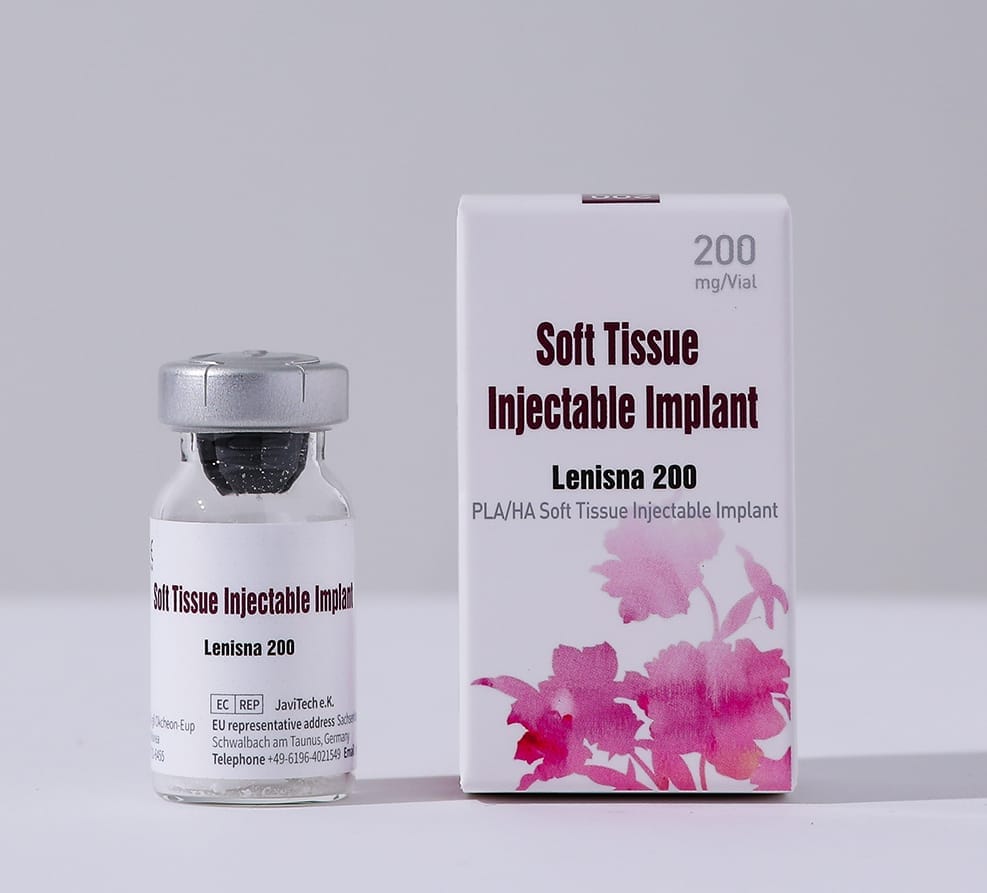
Swelling and bruising are among the more common reactions after Lenisna or Sculptra injections.
Less commonly, nodules or other complications can develop weeks or months later.
Safety depends on more than the product itself. A thorough medical assessment, careful injection technique, and appropriate follow-up all matter.
Downtime and Common Side Effects After Treatment
After Lenisna or Sculptra injections, you may experience redness, swelling, tenderness, or bruising around the treated area.
These reactions are generally temporary, although recovery times vary between individuals.
At BIANCA CLINIC, we advise that redness and swelling after Lenisna injections often settle within several hours to approximately two days. If bruising occurs, it may take around one to two weeks to resolve.
Downtime after Sculptra also varies depending on the treatment area and individual response.
For international patients traveling to Tokyo for treatment, we recommend allowing sufficient time for recovery and avoiding treatment immediately before important events or long-distance flights.
Nodules, Other Risks, and What to Check Before Treatment
Both PDLLA-based Lenisna and PLLA-based Sculptra may cause nodules, delayed inflammatory reactions, or infections after injection.
Lenisna contains spherical PDLLA particles designed to minimize excessive stimulation of surrounding tissues and reduce the risk of inflammatory reactions and nodule formation.
However, this does not eliminate the possibility of complications, and there is insufficient direct comparative evidence to conclude that Lenisna is safer than Sculptra.
If an injectable product is inadvertently introduced into a blood vessel, serious complications, including tissue injury or visual impairment, may occur.
Sudden severe pain, unusual skin discoloration, or changes in vision require immediate medical attention.
Before treatment, your physician should review your previous injectable treatments, medical history, and any contraindications.
A thorough understanding of facial anatomy, appropriate clinical assessment, and careful injection technique are essential to reducing avoidable risks.
What to Know Before Getting Lenisna in Tokyo, Japan
If you are considering Lenisna treatment while visiting Japan, it is important to understand whether the recommended treatment schedule can fit within your stay and how follow-up care will be arranged.
How Many Lenisna Sessions Are Needed?
At BIANCA CLINIC, we generally recommend an initial course of three Lenisna sessions, spaced approximately one month apart.
Afterward, maintenance treatment may be considered every six to twelve months, depending on your skin condition and response to treatment.
Although it may be possible to receive one session during a short visit to Tokyo, completing the full recommended initial course may not be practical.
Sculptra also commonly requires multiple sessions.
According to its official treatment guidance, patients receive an average of two to three sessions over several months, although the actual number is determined individually.
If you live outside Japan, it is worth discussing your travel schedule, opportunities for return visits, and access to follow-up care after returning home.
BIANCA CLINIC’s Consultation and Treatment Approach
At BIANCA CLINIC, we believe that choosing a collagen-stimulating injectable starts with understanding your facial anatomy and the underlying causes of your concerns—not simply selecting a product based on its popularity.
During your consultation, our physicians assess factors such as the location and degree of facial volume loss, skin condition, and your desired results.
Based on these findings, we consider whether Juvelook Volume (Lenisna) is an appropriate option and develop an individualized treatment plan, including injection areas, product amounts, and session timing.
Our clinic also has physicians who provide consultations in English, including Dr. Yukitaro Ikeda.
Please contact us in advance to confirm availability and appointment arrangements.
BIANCA CLINIC offers complimentary interpretation and counseling services for international patients.
Please note that an additional fee may apply when requesting a specific doctor.
If you are traveling from overseas, we also encourage you to discuss expected downtime before your return flight and how any post-treatment concerns will be managed after you leave Japan.
For more information about treatment options and pricing, please visit our official Juvelook Volume (Lenisna) treatment page.
▷Explore Juvelook Volume (Lenisna) Treatment Options and Pricing at BIANCA CLINIC
Frequently Asked Questions About Lenisna vs Sculptra
When comparing Lenisna and Sculptra, questions often come up about natural-looking results, treatment frequency, safety, and how these injectables differ from conventional fillers.
Here are answers to some common concerns.
Q. Which Looks More Natural, Lenisna or Sculptra?
Both treatments can produce natural-looking results as collagen develops gradually.
The final appearance depends on your facial anatomy, the areas treated, and the amount of product injected.
Q. Is Sculptra Better Than Hyaluronic Acid Fillers?
Not necessarily.
Sculptra gradually stimulates collagen production, while conventional HA fillers provide more immediate volume.
The better choice depends on your facial concerns and desired results.
Q. Is Sculptra a Permanent Filler?
No.
Sculptra is not permanent.
Its collagen-stimulating effects develop gradually, and results may last up to approximately two years.
However, longevity varies by individual.
Q. Is Sculptra Considered a Filler?
Sí.
Sculptra is classified as a dermal filler, but it works differently from conventional HA fillers.
Rather than providing immediate volume through a hyaluronic acid gel, it stimulates collagen production to gradually restore facial volume.
Q. Can Lenisna or Sculptra Cause Nodules?
Sí.
Nodules can develop after either treatment, sometimes weeks or months later.
If a lump persists or is accompanied by pain or swelling, consult a qualified physician.
Q. How Many Sessions of Lenisna or Sculptra Do You Need?
Both treatments may require multiple sessions.
BIANCA CLINIC generally recommends three Lenisna sessions about one month apart.
Sculptra commonly involves approximately two to three sessions, although individual treatment plans vary.
Q. Can I Get Lenisna During a Short Trip to Tokyo?
Yes, a single Lenisna session may be possible during a short visit to Tokyo.
However, BIANCA CLINIC generally recommends an initial course of three sessions spaced approximately one month apart.
If you are visiting Japan from overseas, discuss your travel schedule and follow-up care with your physician before treatment.
Q. What Is the Difference Between Lenisna, Sculptra, and Profhilo?
Lenisna and Sculptra primarily aim to improve facial volume through collagen stimulation.
Profhilo is a hyaluronic acid-based injectable mainly used to improve skin hydration, elasticity, and overall skin quality.
Q. Can Collagen Biostimulators Be Combined With Hyaluronic Acid Fillers?
Sí.
They may be combined to address different concerns, such as overall facial volume loss and localized hollow areas.
However, the suitability and timing of combination treatments must be assessed individually by a physician.
Conclusión
Lenisna and Sculptra both stimulate collagen production to support gradual facial volume restoration, but their formulations differ.
Lenisna combines PDLLA with non-cross-linked hyaluronic acid, while Sculptra uses PLLA.
Neither treatment is universally better.
The right choice depends on your facial anatomy, the degree and location of volume loss, your desired results, and your treatment schedule.
At BIANCA CLINIC in Tokyo, our physicians assess these factors to determine whether Juvelook Volume (Lenisna) is suitable for your concerns.
For international patients, we also consider treatment timing, recovery, and follow-up care when planning your visits.
If you are considering Lenisna in Tokyo, explore our Juvelook Volume treatment page to learn more about the procedure, pricing, and consultation options.
▷Considering Lenisna in Tokyo? Explore Treatment Details at BIANCA CLINIC