


La cirugía de la bolsa de los ojos ha llegado a Tokio para quedarse
Para un país con jornadas laborales excesivamente largas, viajes de negocios que obligan a los trabajadores a sacrificar gran parte de su tiempo libre, y constantes videollamadas a top Además, la cirugía de las bolsas de los ojos se ha ganado una merecida reputación por su capacidad de ofrecer un enfoque preciso y médico para refrescar los párpados inferiores de modo que usted Además, la cirugía de las bolsas de los ojos se ha ganado una merecida reputación por su capacidad de ofrecer un enfoque médico preciso para refrescar los párpados inferiores de modo que usted tenga un aspecto descansado en lugar de cambiado o “ congelados”. En Tokio, la mayoría de las personas eligen equipos de cirugía plástica certificados para la cirugía de bolsas de los ojos. Si es nuevo en el cuidado estético, esta guía Si no está familiarizado con los cuidados estéticos, esta guía explica lo esencial de forma clara y amena, para que pueda decidir con confianza si desea consultar a un especialista de Tokio en una clínica de cirugía plástica. Especialmente una que tenga ambiente de spa médico, como BIANCA CLINIC.
¿Qué es la cirugía de bolsas oculares y cuáles son sus beneficios?
Definición
La cirugía de párpados, o como se conoce médicamente, blefaroplastia inferior, es un procedimiento de cirugía plástica que reduce los párpados inferiores hinchados y alisa la parte inferior del ojo. En su mayor parte, los cirujanos modernos de Tokio utilizan un enfoque “transconjuntival”, lo que significa que se hace una incisión en el párpado inferior. Se utiliza especialmente cuando el paciente presenta una leve laxitud cutánea, aunque puede combinarse con un pellizco cutáneo conservador o un pellizco cutáneo conservador o un pellizco cutáneo conservador. combinado con un pellizco cutáneo conservador o un rejuvenecimiento con láser, para un mayor refinamiento de la textura.
Características principales de la cirugía de bolsas oculares
- Incisiones ocultas en el interior de los párpados sin cicatriz externa visible en la mayoría de los pacientes.
- Reposicionamiento de grasa para rellenar el lagrimal, o eliminación selectiva para reducir las bolsas.
- Anestesia local con sedación ligera opcional.tiempos de procedimiento por lo general se sientan en algún lugar de 60-90 minutos.
- El tiempo de inactividad suele ser de varios días, con un pico de hinchazón en torno a las 48-72 horas, que va desapareciendo gradualmente a lo largo de 1-2 semanas.
Beneficios de la cirugía de bolsas oculares
- Una mirada “despierta” rejuvenecida, conservando la forma y luminosidad naturales de sus ojos.
- Mejora duradera del contorno en comparación con los inyectables temporales.
- Las técnicas de alta precisión asociadas a la cirugía plástica en Tokio minimizan el traumatismo tisular y favorecen una recuperación más suave.
Por qué elegir Tokio para la cirugía de bolsas oculares
Japón, y de hecho la cultura sanitaria de Tokio, hace hincapié en la limpieza, la seguridad y la fiabilidad. Son atributos muy apreciados en el sector de la cirugía plástica, y las clínicas de Tokio suelen seguir normas internacionales de esterilización que incluyen microscopía avanzada y suturas finas, así como protocolos de documentación meticulosos. Muchos equipos también ofrecen planes de postratamiento transparentes y asistencia multilingüe, lo que ayuda a los pacientes a mejorar su calidad de vida. Muchos equipos también ofrecen planes de postratamiento transparentes y asistencia multilingüe, lo que ayuda a los visitantes y residentes extranjeros a sentirse cómodos independientemente de si se someten o no a una operación de bolsas en los ojos.
Estándares de la Cirugía Plástica en Tokio
Los cirujanos certificados de Tokio dan prioridad a una planificación conservadora y basada en la anatomía. Esperar mediciones cuidadosas, la discusión de movimiento de grasa frente a la eliminación, y un plan personalizado que equilibra la estética con la función (película lagrimal, el apoyo muscular, y la posición del párpado). Este enfoque mesurado es exactamente la razón por la que la cirugía de bolsas de los ojos realizada por especialistas en cirugía plástica en Tokio es conocida por sus resultados refinados y naturales.
Comparación de tratamientos similares
En CLÍNICA BIANCA entendemos la necesidad de comparar, especialmente cuando se trata de un problema que potencialmente podría solucionarse con métodos alternativos. He aquí una lista de algunos efectos, resultados y riesgos de tratamientos alternativos, comenzando por la Cirugía de Bolsas Oculares:.
Cirugía de la bolsa del ojo (blefaroplastia inferior)
El efecto es estructural, con una longevidad media de varios años. El dolor es leve y se trata con medicación oral, con riesgo de hematomas temporales, sequedad y, sólo en muy raras ocasiones, malposición. El dolor es leve y se controla con medicación oral, con riesgo de hematomas temporales, sequedad y, sólo en muy raras ocasiones, malposición.
Inyección de baby colágeno (colágeno tipo III) bajo los ojos
Esta inyección amortigua sutilmente los huecos y suaviza las líneas finas, pero no elimina la grasa. La longevidad esperada es de 3-6 meses, con tiempos de inactividad medios mínimos. Los únicos riesgos asociados a las inyecciones de colágeno infantil son la hinchazón y la inflamación. Los únicos riesgos asociados a las inyecciones de colágeno en bebés son la hinchazón/irregularidad; por lo tanto, el procedimiento funciona mejor con un inyector experimentado que pueda reducir el riesgo de que se produzcan estos problemas.
Rejuvenecimiento con láser (CO2/erbio)
Por lo tanto, tampoco trata el prolapso de grasa. El único riesgo significativo es el cambio temporal de pigmentación en algunos tipos de piel. El único riesgo significativo es el cambio temporal de pigmentación en algunos tipos de piel.
Microagujas de radiofrecuencia.
Se trata de otro tratamiento centrado en el estiramiento moderado, pero con el incentivo añadido de la mejora de la textura. Existe un riesgo menor de hinchazón leve, pero suele remitir sin necesidad de cuidados adicionales. Existe un riesgo menor de hinchazón leve, pero suele remitir sin necesidad de cuidados adicionales.
Por último, si la hinchazón está causada por grasa herniada, la cirugía es la opción más definitiva. si lo que le preocupa son los huecos o las líneas finas, los tratamientos no quirúrgicos pueden ser suficientes. Una consulta meditada en Tokio puede ayudarle a elegir.
Flujo de trabajo de la cirugía de bolsas oculares de BIANCA CLINIC en Tokio
Como modelo de atención estructurada, esto es lo que un flujo típico paso a paso se verá como si usted decide obtener su tratamiento con nosotros en BIANCA CLINIC en Tokio ( aunque los detalles varían de una persona a otra):.
1) Consulta:. En primer lugar, los pacientes se ponen en contacto con nosotros a través de nuestro sitio web o por teléfono, y les respondemos rápidamente en inglés.
2) Consulta en inglés:. Un especialista en Cirugía Plástica revisa los objetivos, el historial médico y toma fotos estandarizadas para la planificación con comparación del antes y el después.
3) Simulación digital y explicación:. El cirujano explica la eliminación de grasa frente al reposicionamiento, el tipo de incisión y el plazo de tiempo previsto para la inflamación.
4) Comprobación de seguridad:. A continuación se toman los resultados de laboratorio preoperatorios necesarios y se revisan los medicamentos y alergias para garantizar la seguridad.
5) Día de la cirugía:. A continuación, se utiliza un abordaje transconjuntival en pacientes adecuados con En pacientes adecuados, se utiliza un abordaje transconjuntival con una hemostasia meticulosa para garantizar el menor número posible de hematomas.
6) Sala de recuperación:. A continuación, se utilizan compresas frías, se dan instrucciones y se facilitan los datos de contacto en caso de emergencia (por si los necesita).
7) Visitas de seguimiento:. Compruebe la cicatrización, retire las suturas externas si se ha realizado un pellizco cutáneo y revise las primeras fotos del antes y el después.
8) Ayuda a largo plazo:. A continuación, le proporcionamos acceso al equipo para preguntas continuas (en caso de que tenga alguna) con el mantenimiento del cuidado de la piel o el uso de láseres planificados para obtener ayuda adicional. ayuda.
Cirugía de las bolsas de los ojos Resultados antes y después
Inmediatamente después de la intervención, la hinchazón es la más visible, siendo los 2-3 primeros días los peores y mejorando después de forma constante. En cuanto a la vuelta al trabajo, muchos pacientes se sienten más presentables después de 5-7 días con maquillaje, aunque el contorno final suele asentarse en torno a las 6-12 semanas. -Aquí es donde las fotos del antes y el después resultan especialmente útiles para seguir los progresos y perfeccionar los cuidados, sin olvidar nunca que Nuestro objetivo en Tokio, es un aspecto descansado que los amigos noten como natural y fresco, no artificial.
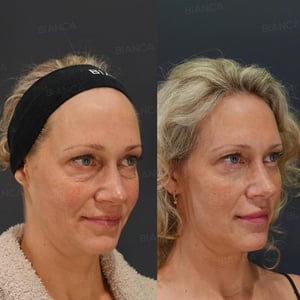
Izquierda: antes, derecha: después
Coste: Hamra Technique ¥602.580 / Morpheus8: ¥77.000
Riesgos: hematomas, hinchazón, asimetría, contractura, ectropión, etc.
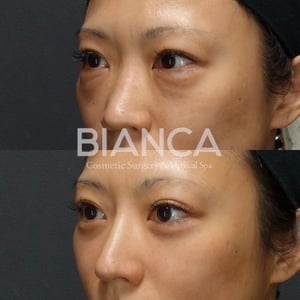
Arriba: Antes de la operación / Abajo: 1 mes después de la operación
Coste: Glamour Line ¥348,000 , Corrección de ojeras y flacidez ¥298,000 , Hialuronidasa: ¥30,000 , JUVÉDERM® VOLUX ¥118,000
Riesgos: hinchazón, hematomas, asimetría, cicatrices, infección, hematoma, anafilaxia, etc.
Consejos para el postratamiento y la recuperación
Si decide someterse a una cirugía de bolsas oculares, le recomendamos lo siguiente:.
- Utiliza compresas frías durante las primeras 48 horas, después cambia a calor suave (si se aconseja).
- Mantenga siempre la cabeza elevada al dormir durante una semana para garantizar los mejores resultados.
- Utilice el colirio/ungüento prescrito según las indicaciones y evite frotarse en todo momento.
- Se recomienda no hacer ejercicio intenso durante al menos una o dos semanas y evitar piscinas y saunas hasta que el médico lo autorice.
- Las lentes de contacto son adecuadas, pero sólo después de una semana aproximadamente. Las gafas son adecuadas mucho antes.
- La protección solar es esencial, con gafas de sol y FPS +50 muy recomendables para reducir el riesgo de pigmentación.
Preguntas frecuentes: Cirugía de las bolsas de los ojos y cirugía plástica
¿Le dolerá?
Durante la intervención, la anestesia local y la sedación opcional le mantendrán cómodo. -2 días, soportables con analgésicos habituales.
¿Cuánto cuesta en Tokio?
En Tokio, la blefaroplastia inferior se suele presupuestar en un rango transparente tras la consulta, con un postratamiento detallado. Una clínica de cirugía plástica de confianza le proporcionará un presupuesto claro antes de que se decida.
¿Cuáles son los riesgos?
Entre los efectos temporales más comunes se incluyen hinchazón, hematomas y sensación de ojo seco. La elección de un equipo de cirugía plástica con experiencia en Tokio reduce estos riesgos y garantiza una asistencia rápida en caso de que surjan problemas.
¿Cuánto duran los resultados?
Los resultados son duraderos porque el procedimiento se dirige a la grasa y la estructura. el envejecimiento natural continúa, pero para la mayoría de las personas, disfrutan de la mejora durante muchos años.
¿Soy un buen candidato?
Puede ser adecuado si tiene hinchazón persistente debajo de los ojos como resultado de depósitos de grasa, buena salud ocular y expectativas realistas. Evaluaremos la calidad de la piel, el tono muscular y la salud de la superficie ocular durante una consulta en Tokio, así que venga preparado para un examen completo.
¿Sigue interesado en saber más sobre la cirugía de bolsas oculares?
En realidad, la cirugía de las bolsas de los ojos puede ser una forma muy práctica y duradera de lucir un aspecto descansado al tiempo que se mantiene fiel a sus rasgos naturales. Si desea una conversación suave y sin presiones sobre las opciones, póngase en contacto con BIANCA CLINCA. Si desea una conversación suave y sin presiones sobre las opciones, póngase en contacto con BIANCA CLINIC para una consulta gratuita. Un equipo de la clínica de belleza de habla inglesa le guiará paso a paso a través de la planificación, la cirugía y el postratamiento, para que se sienta informada, segura y respaldada desde la primera consulta hasta el antes y el después finales. desde la primera consulta hasta la revisión final del antes y el después.
Biografía.

| Dra. Alice Hatade. Cirujana plástica y reparadora titulada / Especialista en cirugía estéticaLa Dra. Alice Hatade es una cirujana plástica y reparadora titulada. Especialista en Cirugía EstéticaLa Dra. Alice Hatade es una cirujana plástica y reconstructiva titulada reconocida por su refinada sensibilidad estética y su dedicación a la obtención de resultados naturales y elegantes. Licenciada por la Facultad de Medicina de la Universidad de Kyushu, una de las instituciones médicas más importantes de Japón, desarrolló su carrera en cirugía plástica y estética en los mejores hospitales universitarios y centros afiliados. cirugía plástica y estética en los mejores hospitales universitarios y centros afiliados. Con una amplia experiencia que abarca desde la cirugía reconstructiva facial y corporal compleja hasta los procedimientos cosméticos avanzados, la Dra. Hatade combina una profunda experiencia en el campo de la cirugía estética con un profundo conocimiento de la medicina estética. Su enfoque característico se centra en lograr una belleza que parezca sin esfuerzo -realzando los rasgos naturales de cada paciente y manteniendo su individualidad. Antes de embarcarse en su carrera médica, la Dra. Hatade actuó como ídolo japonesa durante sus años de estudiante. Estos antecedentes poco comunes le proporcionan una comprensión única tanto de la “belleza que cautiva a los demás” como de la “belleza que nace de la elegancia natural”. ." La Dra. Hatade es admirada por sus pacientes por su serena profesionalidad, su refinado juicio estético y su capacidad para crear un ambiente cálido y discreto en el que Cada consulta es una experiencia personalizada, adaptada para reflejar el estilo de vida, las aspiraciones y la confianza interior del paciente. aspiraciones y confianza interior. Más allá de su consulta, encuentra inspiración en los viajes, la buena mesa y el arte, y comparte reflexivas perspectivas sobre belleza y bienestar a través de su presencia en las redes sociales presencia en los medios. |
Reserve hoy mismo una consulta
📲 ¡Síguenos para estar al día! BIANCA internacional Instagram
🔹 Cómo reservar tu cita.
Haz clic en el siguiente enlace y rellena el formulario con tus inquietudes, código de referencia si lo tienes y día/horario de preferencia.
Se admiten personas sin cita previa.
📝 Nota:. Todas las consultas, tratamientos y visitas de seguimiento incluyen servicios de traducción gratuitos -sin gastos adicionales
Ubicación de las clínicas.
📍 Clínica Ginza
12F Ginza ONE, 1-8-19 Ginza, Chuo-ku, Tokio, Japón
☎ 050-3196-4834
🚇 Acceso:.
🚶♀️ A 4 minutos a pie de Estación de Ginza en la línea Ginza del metro de Tokio.
🚶♀️ A 1 minuto a pie de Salida 7 de la estación de Ginza-itchome en la línea Yurakucho del metro de Tokio.
🚶♀️ A 3 minutos a pie de Salida 3 de la estación de Kyobashi en la línea Ginza del metro de Tokio.
🚶♀️ A 8 minutos a pie de Salida Kyobashi de la estación JR Yurakucho .
📍 Clínica Omotesando
Minami-Aoyama 511 Building 2F, 5-11-10 Minami-Aoyama, Minato-ku, Tokio, Japón
☎ 050-1807-1593
🚇 Acceso:.
🚶♀️ A 5 minutos a pie de Salida B1 de la estación de Omotesando En las líneas Ginza, Hanzomon y Chiyoda del metro de Tokio.
Horario de consulta:. 10:00-19:00 Cerrado:. Vacaciones irregulares
Acerca de la Clínica BIANCA
En BIANCA, redefinimos el cuidado de la belleza ofreciendo un enfoque holístico que trasciende la cirugía estética y la dermatología tradicionales. 20 especialistas 20 médicos especializados en diferentes campos como la cirugía plástica, la dermatología, la medicina interna, la medicina regenerativa y la ginecología escucharán atentamente sus necesidades. Nos comprometemos a crear planes de tratamiento personalizados con precisión y cuidado, y a garantizar que experimente la belleza y el bienestar desde el interior. Nos comprometemos a crear planes de tratamiento personalizados con precisión y cuidado, y a garantizar que experimente el verdadero espíritu del omotenashi y la hospitalidad japoneses.