



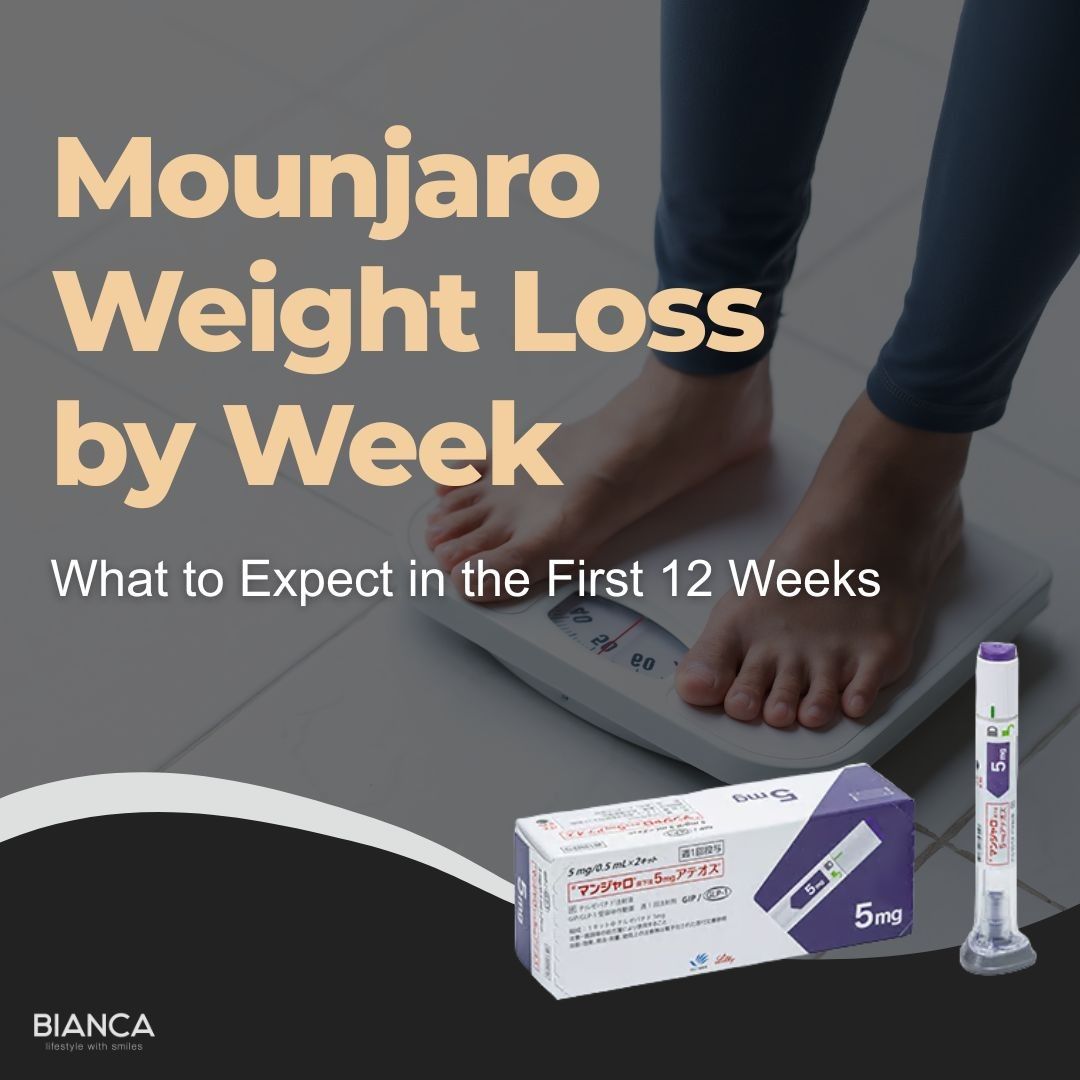
Mounjaro may begin to affect your appetite within the first few weeks. However, there is no medically established amount of weight that everyone should expect to lose each week.
Clinical trials report average changes across large groups over several months, while an individual’s weight may stay the same, decrease, or temporarily rise from one week to the next.
Online timelines can be helpful for understanding the general treatment process. They should not be interpreted as personal weight-loss targets.
In Japan, Mounjaro, or tirzepatide, is approved for the treatment of type 2 diabetes. Its use for cosmetic weight loss or obesity treatment is off-label and self-funded.
At BIANCA CLINIC, every treatment plan begins with a physician consultation, including a review of your BMI, medical history, and current medications. When appropriate, an initial blood test is then performed before treatment begins.
How Much Weight Can You Lose per Week on Mounjaro?

Nuk ka asnjë universale Mounjaro weight loss per week figure. In the 72-week SURMOUNT-1 trial*, tirzepatide was introduced at 2.5 mg and increased gradually. The long-term results cannot simply be divided by 72 to create an accurate weekly prediction.
Weight loss rarely follows a perfectly straight line. Early changes may reflect shifts in body water as well as fat loss. Appetite response, dose schedules, food intake, hydration, and possible side effects also vary from person to person.
Why Clinical Trial Averages Are Not Personal Weekly Targets
A clinical trial average is not the same as an individual expected range or a medically appropriate personal goal.
For example, two people may lose the same percentage of their starting weight over three months but follow completely different weekly patterns. One may lose a small amount consistently. The other may see little change for several weeks before the scale begins to move.
For this reason, we look at Mounjaro weight loss results by week as an overall trend rather than judging progress from a single weigh-in.
* Source: N Engl J Med. 2022;387(3):205-216
https://www.nejm.org/doi/full/10.1056/NEJMoa2206038
Mounjaro Weight Loss Week by Week: What May Happen During Each Phase

| Treatment phase | Typical dose stage | What you may notice | Main clinical focus |
| Weeks 1–4 | Starting dose | Appetite changes, digestive symptoms, small or inconsistent weight changes | Tolerability, hydration, nutrition, and injection technique |
| Weeks 5–8 | Possible dose adjustment | Clearer appetite control or continued gradual change | Treatment response, side effects, and suitability for adjustment |
| Weeks 9–12 | Individualized treatment | A clearer overall trend may begin to emerge | Weight trend, waist measurement, nutrition, and adherence |
| Month 4 onward | Maintenance or further adjustment | Continued loss, slower progress, or a plateau | Long-term safety, body composition, habits, maintenance |
This table describes common treatment phases. It does not guarantee results or represent a mandatory dose-escalation schedule.
Weeks 1–2—Adjustment May Matter More Than the Scale
Treatment usually begins with a low introductory dose. During the first two weeks, some people notice less hunger, earlier fullness, fewer cravings, or gastrointestinal symptoms such as nausea. Others see little or no change on the scale.
A larger early drop may partly reflect changes in food intake, carbohydrates, salt, or hydration. It does not necessarily represent fat loss alone. Similarly, no weight loss in week 1 does not mean the treatment has failed.
At this stage, the physician is often more focused on whether you can eat adequately, stay hydrated, tolerate the medication, and use the injection correctly than on reaching a particular number.
Weeks 3–4—Look for a Trend, Not a Weekly Target
As the introductory phase continues, your appetite response may become clearer. You may notice gradual weight loss, an unchanged week followed by a decrease, smaller portions without a dramatic change on the scale, or differences in your waist measurement and how your clothes fit.
Do not increase the dose on your own because your progress appears slower than an online Mounjaro weight loss week by week chart.
At BIANCA CLINIC, treatment generally begins with 2.5 mg for four weeks. Your physician then reviews side effects, response to treatment, and overall health before considering a transition to 5 mg.
Weeks 5–8—Dose Decisions Should Be Based on More Than Weight
Some patients may move to 5 mg after the introductory phase. However, a higher dose is not simply a way to pursue faster weight loss.
During your consultation, the physician may review:
- Appetite control and the overall weight trend
- Nausea, vomiting, diarrhea, or constipation
- Protein, nutrient, and fluid intake
- Fatigue and daily functioning
- Medical conditions and current medications
- Starting BMI and individual treatment goals
The most appropriate dose is one that provides an appropriate treatment response while remaining tolerable. It is not automatically the highest available dose.
Weeks 9–12—The Overall Pattern Becomes More Informative
By weeks 9–12, you and your physician may have a clearer picture of your appetite, weight trend, side effects, food quality, and ability to maintain healthier habits.
Even at 12 weeks, the result should be interpreted alongside your starting weight, dose history, missed injections, activity level, sleep, stress, constipation, fluid retention, menstrual-cycle changes, and possible changes in muscle mass.
There is no single percentage that everyone should reach by week 12.
Month 4 and Beyond—Progress May Slow or Plateau
Long-term weight loss often slows over time. As body weight decreases, energy requirements may also fall. Changes in eating patterns, activity, sleep, stress, constipation, or fluid retention may also affect the number on the scale.
A weight-loss plateau is not a reason to double the dose, inject early, add another medication, skip meals, or stop treatment suddenly.
Instead, it is a good time to review the treatment plan with your physician.
Why You May Lose No Weight—or Gain Weight—During One Week

One unchanged or higher weigh-in does not necessarily mean that Mounjaro has stopped working.
Possible reasons include:
- Normal fluid fluctuations
- Salt or carbohydrate intake
- Constipation
- Menstrual-cycle changes
- Weighing at a different time
- Travel, poor sleep, or reduced activity
- Dehydration
- Changes in muscle mass
- Different clothing or measuring conditions
When Should Slow Progress Be Discussed With a Physician?
Contact your clinic if your appetite has not changed after an appropriate treatment period, your weight continues to increase over several weeks, or side effects prevent you from eating or drinking adequately.
You should also speak with your physician before changing your dose.
Seek medical advice promptly if you experience severe or persistent symptoms, marked weakness, dizziness, unusual fatigue, or a possible dosing or injection error. The number of kilograms lost should never be the only reason to ask for medical support.
Faster Weight Loss Is Not Always Better
The goal is not to create the largest possible weekly drop.
Rapid weight loss may increase concerns about dehydration, inadequate nutrition, loss of lean muscle, fatigue, reduced physical performance, and difficulty maintaining the result. Skin laxity or changes in facial volume may also become more noticeable when weight falls quickly.
A Balanced Body-Management Approach at BIANCA CLINIC
At BIANCA CLINIC, weight management is about more than the number on the scale. Depending on your health, lifestyle, and goals, a balanced plan may include:
- Adequate protein and nutrient intake
- Sustainable calorie reduction
- Resistance exercise when appropriate
- Monitoring energy levels and gastrointestinal symptoms
- Reviewing laboratory results
- Evaluating lifestyle and medical history
- Planning for weight maintenance as well as weight loss
Our Wellness & Anti-Aging approach considers nutrition and lifestyle alongside each patients medical condition and goals.
This approach cannot guarantee that muscle loss, skin laxity, or weight regain will be prevented. It does, however, support more thoughtful and individualized treatment planning.
How to Track Mounjaro Weight Loss More Meaningfully
Try to measure your progress under consistent conditions and focus on the broader pattern.
Helpful items to track include:
- Body weight and weekly or biweekly averages
- Perimetri i belit
- Appetite and fullness
- Protein and fluid intake
- Digestive symptoms and energy levels
- Physical activity
- Injection date and dose
- Questions for your next consultation
Daily weighing is not always necessary. Short-term fluctuations can create unnecessary anxiety and make the overall trend harder to see.
A simple tracker is usually more useful than a calculator claiming to predict your personal Mounjaro expected weight loss per week.
▶Learn More About Mounjaro Treatment at BIANCA CLINIC
Starting Mounjaro in Tokyo as an International Patient

For international patients considering Mounjaro treatment in Tokyo, it is important to confirm not only treatment eligibility, but also pre-treatment testing and the follow-up plan during and after their stay in Japan.
Medical Assessment Before Treatment
Before prescribing Mounjaro, the physician will review your BMI, weight-management goals, medical history, current medications, previous GLP-1 or GIP/GLP-1 treatments, gastrointestinal conditions, and other relevant safety factors.
At BIANCA CLINIC, initial blood testing helps us assess your health before treatment and provides baseline information for follow-up.
Mounjaro is not suitable for everyone. Prescription depends on a physician’s assessment.
Treatment Timing for Visitors to Japan
International visitors should consider whether they have enough time for a consultation and initial testing. It is also important to discuss whether starting treatment immediately before a long flight is appropriate and how the medication should be stored during travel.
Before leaving Japan, make a plan for follow-up care and know who to contact if side effects occur after you return home.
Mounjaro should not be viewed as a short-term solution for “vacation weight loss.”
English-Language Support and Follow-Up Planning
Before requesting an appointment, confirm the availability of English-language support, how to contact the clinic with questions, whether follow-up is available after you leave Japan, and which documents may be needed when traveling with medication.
Please contact BIANCA CLINIC for the latest information about language support and appointment arrangements.
▶Learn About Mounjaro in Tokyo
Pyetje të shpeshta
How Much Weight Can You Lose in the First Week on Mounjaro?
Some people notice appetite or scale changes during the first week, while others do not. A one-week result cannot reliably predict your long-term response.
Early weight changes may also reflect shifts in body fluid rather than fat loss alone.
Is It Normal to Lose No Weight During Weeks 1–4?
Yes. The first four weeks are generally an introductory phase, and appetite and weight responses vary.
It is more helpful to review progress over time than to judge the treatment based on a single week.
What Is the Average Weekly Weight Loss on Mounjaro?
Clinical trials report average changes over several months. They do not guarantee a specific amount of weight loss each week.
Dividing a long-term percentage by the number of treatment weeks does not accurately predict how an individual’s weight will change.
Does Increasing From 2.5 mg to 5 mg Cause Faster Weight Loss?
Not necessarily. A dose adjustment may affect appetite and weight response, but it may also affect tolerability.
Your physician should determine whether a dose change is appropriate based on your symptoms, overall progress, and medical condition—not solely on a desire to lose weight faster.
Why Did I Gain Weight During One Week on Mounjaro?
A temporary increase may result from fluid retention, salt intake, constipation, menstrual-cycle changes, travel, or different weighing conditions or times of day.
If your weight continues to rise over several weeks, discuss the trend with your physician.
When Does Mounjaro Weight Loss Usually Become Noticeable?
Some people notice changes during the first few weeks, while others need more time.
A clearer trend may emerge over the first two to three months, although the timing and degree of change vary by individual.
Can I Lose Weight on Mounjaro Without Changing My Diet or Exercise Habits?
Mounjaro may reduce appetite, but sustainable weight management also depends on food quality, nutrient intake, physical activity, sleep, and long-term habits.
The medication should form part of a broader, medically guided plan rather than replace healthy lifestyle choices.
Can International Patients Start Mounjaro While Visiting Tokyo?
Possibly. However, suitability must first be determined through a physician consultation.
International visitors should also plan for initial blood testing, medication storage, possible side effects, and follow-up after leaving Japan.
Përfundim
Mounjaro weight loss by week does not follow one fixed schedule. The first month is generally an adjustment period, and the overall trend becomes more meaningful over several weeks or months.
Faster weight loss is not always healthier or easier to maintain. Dose changes, slow progress, or a plateau should be reviewed with a physician rather than managed independently.
Because individual weight-loss patterns vary considerably, treatment progress should be evaluated over time rather than by weekly changes alone. Physician-guided dose adjustments and long-term lifestyle support remain essential for safe and sustainable weight management.
International patients considering Mounjaro in Tokyo can request a consultation at BIANCA CLINIC to discuss eligibility, medical history, expected treatment progression, and an individualized weight-management plan.